


{{goods.model}}
7 in 1 CNC Wood Lathe Technical Exchange with Indian Distributor
On June 1, 2026, a team of long-standing Indian distributors visited the CATEKCNC manufacturing facility. The visit centered on a two-day technical exchange focused on the company’s flagship product—the 7-in-1 CNC wood lathe. Unlike typical client visits, which usually consist only of factory tours and business negotiations, this visit emphasized discussions on actual machining processes, real-world woodworking production challenges, and process optimization for complex woodworking applications.
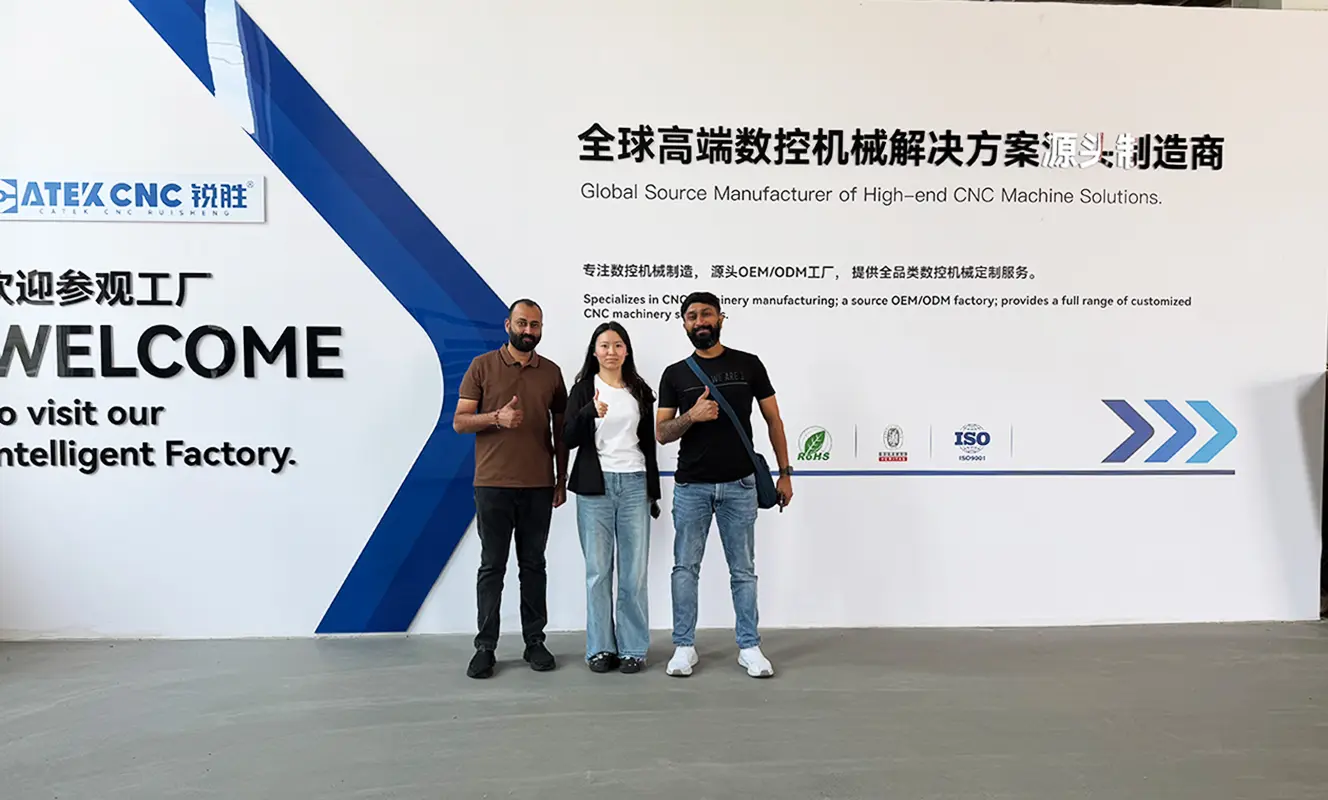
Over the past few years, the distributor has supplied CNC wood lathe machines and multi-function CNC woodworking machines to various Indian woodworking factories, including solid wood furniture production workshops, staircase manufacturers, decorative carving businesses, and custom woodworking companies. As the India woodworking market competition intensifies, Indian woodworking manufacturers are no longer focused solely on purchasing CNC equipment at lower prices. An increasing number of factories are prioritizing production flexibility, machining consistency, workshop efficiency, and the ability to process complex custom products without heavy reliance on manual labor.
This shift is particularly evident in India’s rapidly growing custom woodworking industry. Many factories now receive highly diverse orders involving different dimensions, irregular shapes, carved surfaces, and a variety of machining requirements that may appear within a single batch of products. Traditional woodworking production methods typically require multiple standalone machines to perform operations such as turning, carving, drilling, sanding, and milling. For small factories with limited workshop space and labor resources, this production structure leads to persistent inefficiencies.
During this visit, the Indian team hoped to gain an in-depth understanding of how this 7-in-1 CNC woodworking lathe system can help local factories streamline production processes, reduce repetitive machine adjustments, improve the consistency of finished products, and resolve challenging machining issues that arise in daily production.
I. Why multi-function CNC woodworking machines are becoming more popular in india
Many small woodworking workshops in India operate under highly practical production conditions. Workshop space is often constrained, labor costs are rising steadily, and customer orders typically involve custom wood products rather than standardized mass production. A single workshop might produce chair legs in the morning, carved temple components in the afternoon, and decorative furniture parts the next day. Under these circumstances, traditional single-function wood lathe machines can create significant production bottlenecks.
Indian distributors explain that many customers previously relied on standalone woodturning lathes, carving machines, drilling machines, and sanding equipment. While these machines can perform single tasks, production efficiency becomes extremely low once a product requires multiple processing steps. Workers must constantly move workpieces between machines, repeatedly adjust the material, recalibrate positions, and manually correct errors caused by re-clamping.
For factories processing custom furniture production machine applications and irregular woodworking products, this repetitive workflow consumes a significant amount of labor time and significantly reduces production efficiency. More importantly, repeated repositioning often leads to inconsistent product dimensions, especially when machining irregular wooden components or high-precision decorative parts.
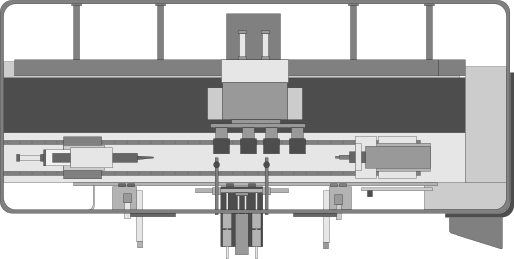
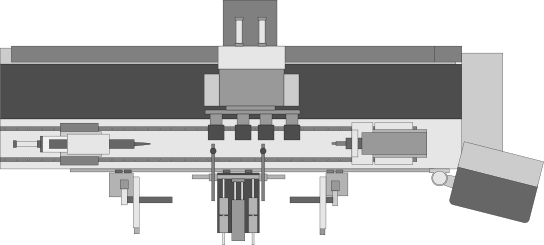
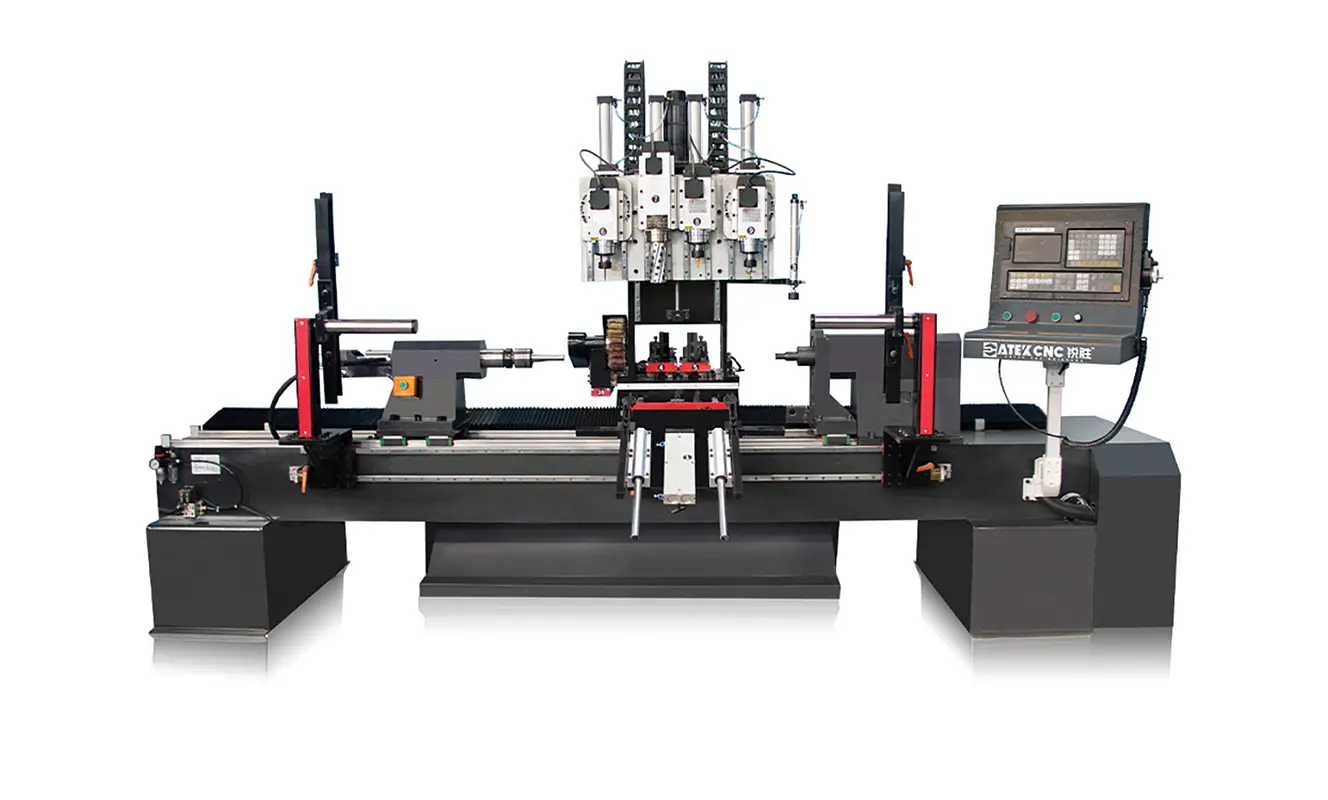
This is precisely why the 7-in-1 CNC woodworking lathe has gained popularity among Indian manufacturers. By integrating multiple woodworking functions into a single, coordinated system, factories can complete processes such as turning, carving, milling, drilling, twisting, grooving, and sanding within a single production workflow. Operators do not need to transfer materials between different machines; most machining operations can be completed with a single, coordinated setup.
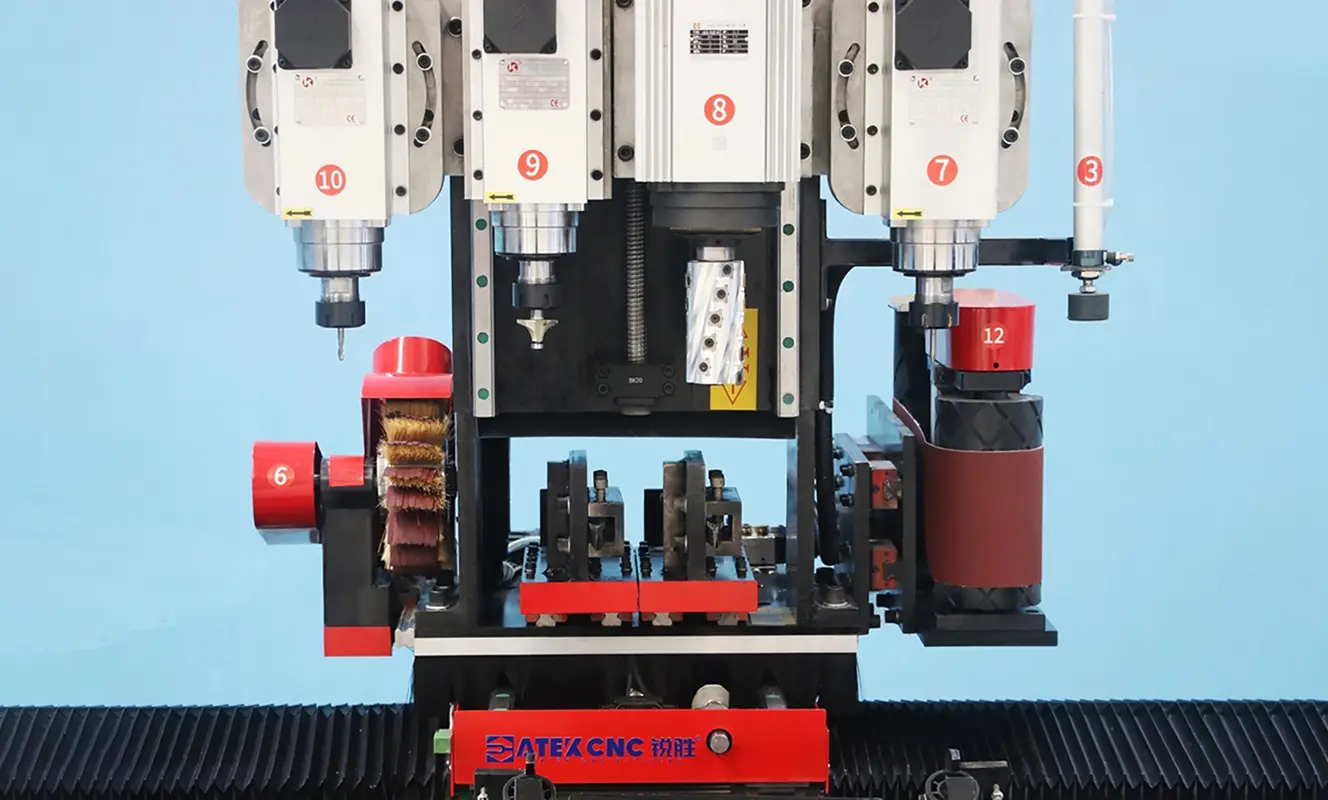
For many Indian customers, the value of this approach goes beyond simply “saving on machinery.” The real advantage lies in reducing production downtime and increasing the workshop’s production speed when handling custom orders.
II. Hands-on technical exchange focused on real machining problems
The CATEKCNC technical team focused primarily on providing guidance regarding the practical production challenges raised by their Indian distributor clients.
The sales team brought samples, photos of machined parts, and feedback on machining collected from local customers in Indian custom furniture market. Most of these issues involved irregularly shaped wood components, edge chipping during high-speed cutting, inconsistent engraving quality on dense materials, and vibration marks appearing on the surface during prolonged machining.
To better analyze these issues, engineers mounted several sample workpieces directly onto the demonstration machine for on-site testing.
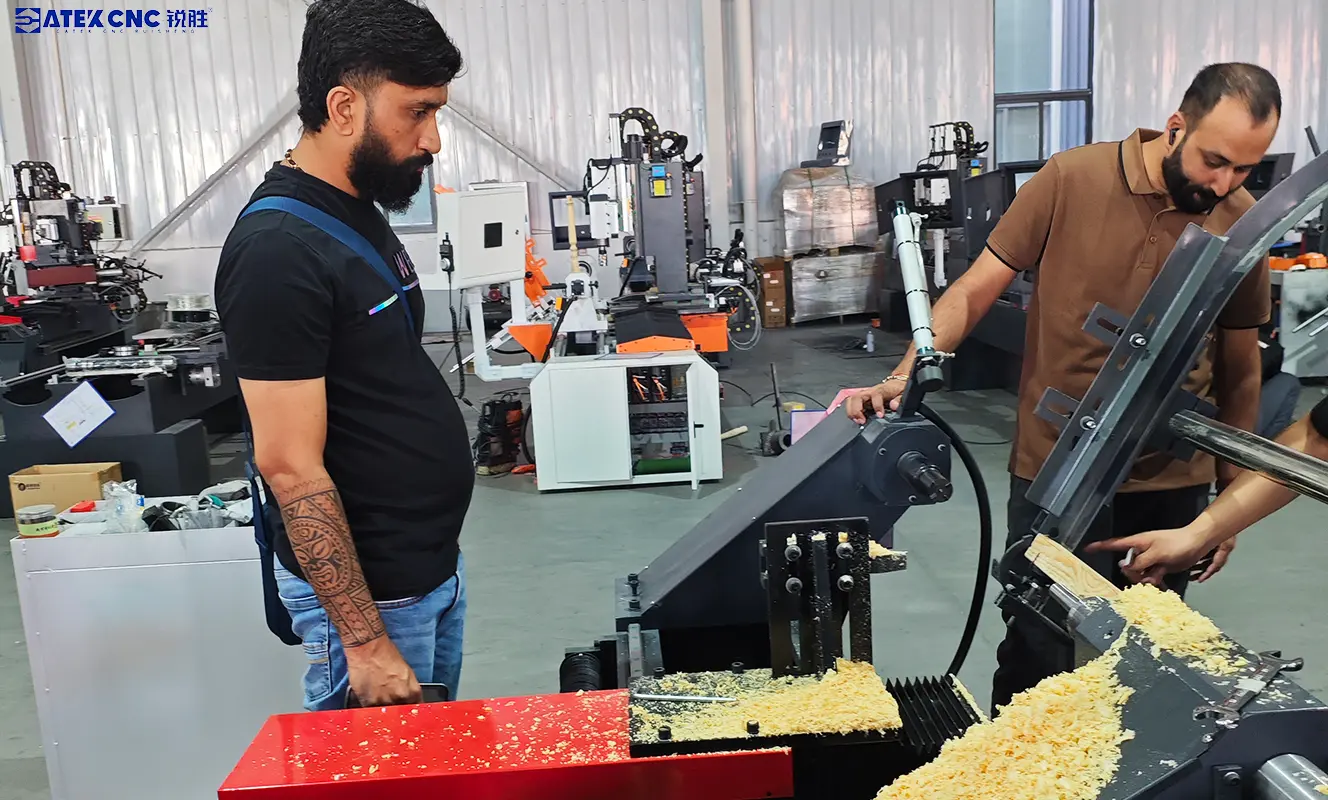
According to the dealer, the local factory sometimes encounters issues with fine cracks along the edges and inconsistent surface smoothness when machining intricately carved areas. Rather than simply explaining theoretical solutions, CATEK CNC engineers conducted on-site machining tests, gradually adjusting the spindle speed, feed rate, cutting angle, and toolpath parameters of the CNC woodworking lathe.
During the initial cutting phase, slight vibration was still observable near the sharp edge areas. The engineers then gradually optimized the cutting logic and adjusted the spindle torque output based on the material density. After several rounds of parameter adjustments, surface finish improved markedly, and the quality of the engraved edges also showed significant improvement.
At the machining site, Indian technicians carefully inspected the machined samples by hand, repeatedly examining the edges and observing the surface under various lighting conditions. Members of the Indian distributor’s team used their cell phones to record the parameter settings and machining process for use during subsequent customer training sessions in India.
III.How integrated CNC production improves manufacturing efficiency
Another focus of this visit was workflow optimization.
Many woodworking shops in India still assign processes such as turning, carving, drilling, and sanding to separate workstations. Although this traditional model remains common, it can cause significant production delays once a shop begins handling more custom orders.
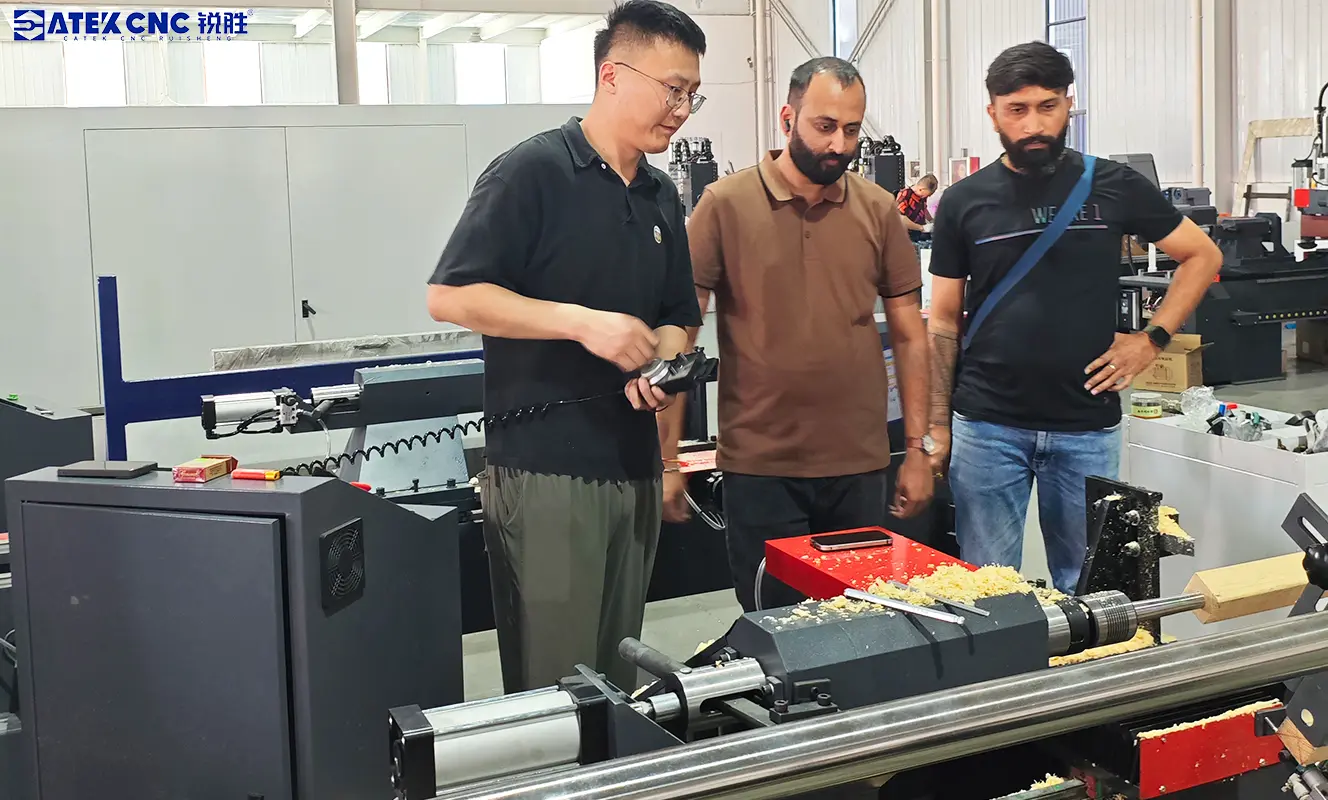
During the demonstration, the engineering team selected a complex, irregularly shaped wooden component that required multiple machining operations. This 7-in-1 CNC wood lathe can complete operations such as rough turning, decorative carving, side milling, drilling, and surface sanding in a single coordinated machining cycle, eliminating the need for multiple machines.
Throughout the entire process, the workpiece remains secured in a single clamping position.
For the Indian dealer team, what was most impressive was not only the machining speed itself but also the elimination of the need for repeated repositioning and secondary calibration. In many traditional workshops, workers spend a significant amount of time manually adjusting materials between different machines. Each repositioning increases the risk of dimensional deviations and human error.
By reducing these repetitive operational steps, the integrated CNC woodworking system significantly improves production efficiency and the consistency of finished products.
Based on observations from demonstration tests, the complete machining cycle can reduce production time by nearly 40% compared to traditional multi-machine workflows. For factories processing large volumes of custom wood products, this advantage can significantly boost production capacity without expanding workshop space or increasing the workforce.
IV.Heavy-duty machine structure designed for continuous industrial operation
Since long-term production stability remains one of the top concerns for industrial woodworking customers, Indian dealers have also spent a significant amount of time inspecting the machines’ internal mechanical structures.
In many high-volume production workshops, CNC machines operate continuously for long periods under heavy cutting loads. Under these conditions, lightweight frames often experience vibration issues, which ultimately affect machining accuracy and surface quality.
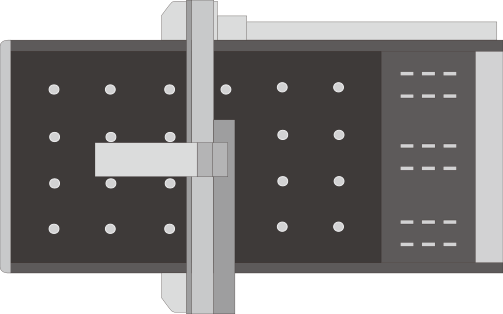
To address this issue, this 7-in-1 CNC woodworking lathe features a heavy-duty gray cast iron structure combined with a dual-row, four-guide rail support system. The machine bed has a wall thickness of approximately 30 millimeters, providing exceptional rigidity during high-speed turning and engraving operations.
In the workshop, the Indian team closely observed the spindle’s performance during continuous heavy-cutting tests. Even under sustained machining loads, the machine maintained stable cutting performance with minimal vibration. The distributor paid particular attention to the spindle’s temperature changes and motion consistency during prolonged operation, as these factors directly impact production in real-world factory environments.
During the inspection, the drive system of the 7-in-1 CNC wood lathe also drew widespread attention. The system utilizes TBI high-precision ball screws and HIWIN linear guides, maintaining stable motion accuracy throughout repetitive machining cycles. This is particularly important for machining products that require consistent dimensional accuracy in high-volume production.
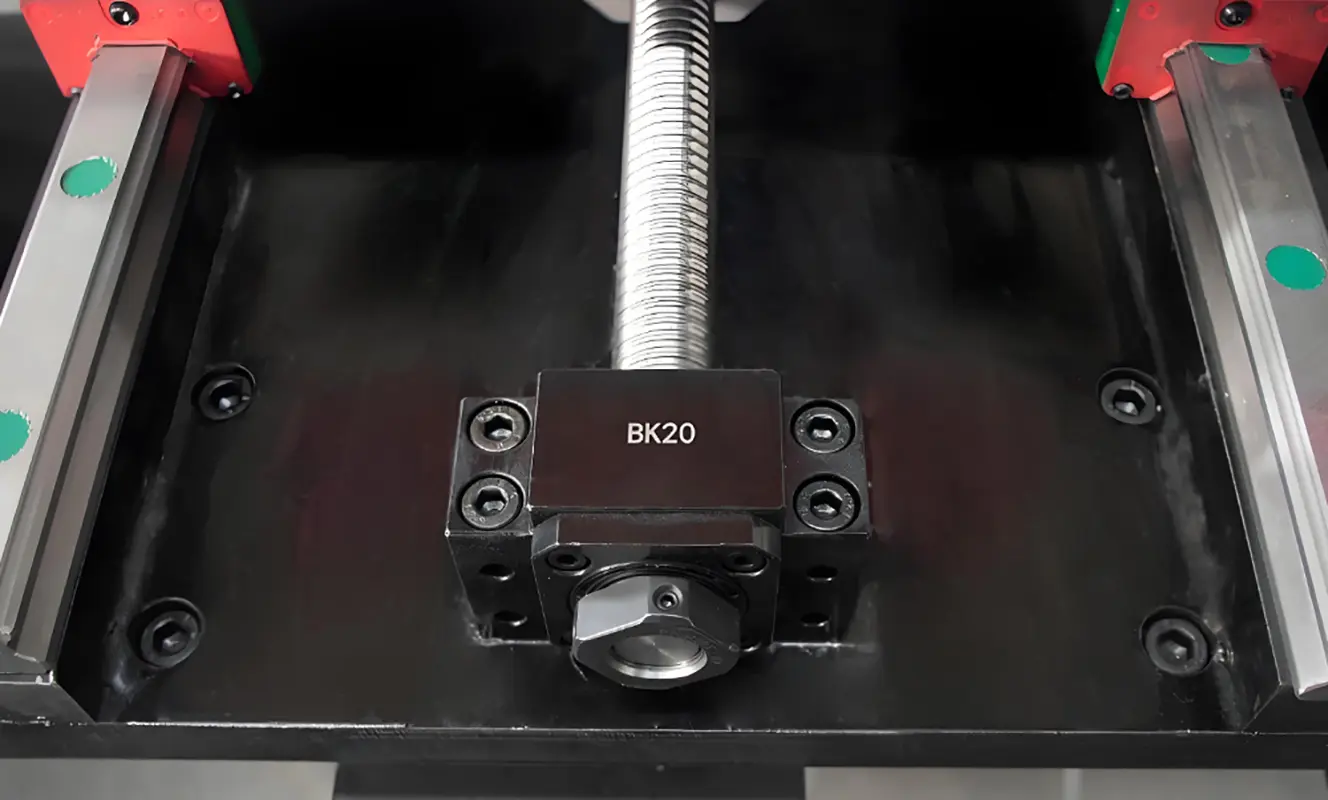
For woodworking shops producing stair railings, furniture legs, decorative columns, and custom carved components, even the slightest positioning deviation can cause serious assembly issues in subsequent production. Dealers explained that as India’s domestic manufacturing standards continue to rise, many Indian customers are placing increasingly higher demands on dimensional consistency.
V. Multi-process capabilities of CNC woodworking lathes
One reason the 7-in-1 CNC woodworking machine is gaining increasing attention in overseas markets is its ability to handle a wide range of woodworking applications within a single system.
Modern woodworking factories rarely produce only a single product category. Many companies now receive mixed orders involving furniture components, decorative architectural elements, wood carvings, and custom-shaped structures. In this production environment, machine flexibility becomes crucial.
The multi-axis control system enables the lathe to perform complex 3D carving operations with extremely high surface precision. During the demonstration, the engineering team showcased multiple carving samples, including curved surfaces, relief patterns, decorative lettering, and twisted structures. The distributor noted that similar products are growing in popularity for high-end furniture projects and temple woodworking applications across India.
In addition to carving capabilities, the CNC woodworking lathe’s integrated milling and drilling functions allow workshops to complete grooving, side holes, and irregular hole machining without transferring workpieces to other equipment. Three 6-kilowatt air-cooled spindles provide stable cutting power even when machining high-density materials or during continuous industrial production.
The integrated sanding function has also attracted widespread attention, as many woodworking factories still rely heavily on manual sanding after machining. By reducing the workload associated with manual sanding, factories can improve the consistency of finished products while reducing labor intensity during the post-processing stage.
VI. Applying CNC machines in indian manufacturing environments
Voltage instability is common in some industrial zones in India, particularly during peak production periods. For CNC equipment operating continuously in woodworking factories, electrical instability increases the risk of downtime and control system interruptions.
To improve reliability under these conditions, this CNC woodworking lathe incorporates industrial-grade electronic components from Schneider Electric and Delixi Electric, while also optimizing the electrical system’s tolerance to voltage fluctuations. During factory discussions, engineers explained how this system configuration helps reduce unexpected production interruptions caused by an unstable power environment.
In addition to electrical stability, ease of maintenance is also crucial for overseas customers. Some woodworking factories may lack experienced CNC technicians, particularly in smaller industrial zones. To address this issue, the company provides distributors and end users with remote technical support, machining guidance, instructional videos, and troubleshooting assistance.
The engineering team does more than simply sell equipment; it works closely with overseas partners to provide process support for complex projects. When customers encounter complex, irregular workpieces or have special machining requirements, engineers can provide remote assistance to optimize toolpaths, recommend cutting strategies, and design customized machining solutions.
For distributors competing in the highly active Indian woodworking market, this level of factory support is a significant advantage, as it enables them to resolve customer issues more quickly and build stronger, long-term business relationships.
VII. Growing demand for flexible CNC woodworking solutions in the indian market
This visit also reflects a broader trend in the global woodworking industry. As custom manufacturing continues to expand, more and more factories are searching for industrial wood turning machines capable of efficiently handling multiple processes within limited production spaces.
For many workshops, purchasing multiple standalone machines is no longer the most practical solution. Instead, integrated CNC wood lathe machines offer greater production flexibility while reducing workshop complexity.
This trend is particularly evident in emerging manufacturing markets, where factories must maximize production efficiency while strictly controlling investment costs. Machines capable of integrating processes such as turning, engraving, drilling, milling, and sanding into a single workflow are becoming increasingly popular, as they help manufacturers respond more quickly to changing customer demands.
Indian distributors explain that today’s customers no longer simply inquire about a machine’s technical specifications. An increasing number of buyers want to understand how woodworking equipment can help them reduce reliance on labor, improve production flexibility, shorten lead times, and boost profitability in real-world production environments.
VIII. FAQ
1. What types of woodworking products can the 7-in-1 CNC wood lathe produce?
The 7-in-1 CNC wood lathe is designed for a wide range of woodworking applications, including furniture components, stair parts, decorative columns, temple carvings, table legs, chair legs, and custom-shaped wooden structures. It is especially suitable for factories handling mixed production orders that require turning, carving, drilling, milling, and sanding within one workflow.
2. How does the 7-in-1 CNC wood lathe improve production efficiency?
The greatest source of efficiency gains comes from eliminating repetitive material handling and re-clamping.
In traditional machining processes, each operation requires moving the workpiece between machines, which increases time loss and dimensional errors. With this integrated system, all operations can be completed in a single setup, reducing total machining time by 30% to 40% depending on the product type.
3. Is it suitable for small woodworking workshops in India?
Absolutely. Many Indian customers have limited factory space and high labor costs.
This versatile woodworking lathe is not only suitable for large-scale industrial production but is also ideal for small and medium-sized factories—and especially for small workshops—because it reduces the need for multiple machines, simplifies workflows, improves production consistency, and requires minimal labor.
4. Can this woodworking lathe be customized to meet different production needs?
Yes. Depending on the specific needs of the workshop, configurations such as spindle power, axis setup, tooling systems, and software features can all be customized. It is suitable for both standard furniture production and highly specialized woodworking applications, such as temple carvings or artistic wood carving.
IX. Conclusion
Through a combination of hands-on demonstrations, discussions on real-time parameter adjustments, structural inspections, and workflow analysis, this exchange helped Indian dealers gain a deeper understanding of how the 7-in-1 CNC wood lathe machine meets the increasingly complex demands of woodworking production.
As India’s woodworking industry continues to evolve toward customization and high-efficiency manufacturing, flexible multi-function CNC woodworking machines capable of integrating multiple machining operations onto a single platform are expected to play an increasingly important role in helping factories enhance their competitiveness, product quality, and long-term manufacturing stability.