


{{goods.model}}
U.S. Customer Visits CATEKCNC to Explore CNC Woodworking Solutions and Custom Manufacturing
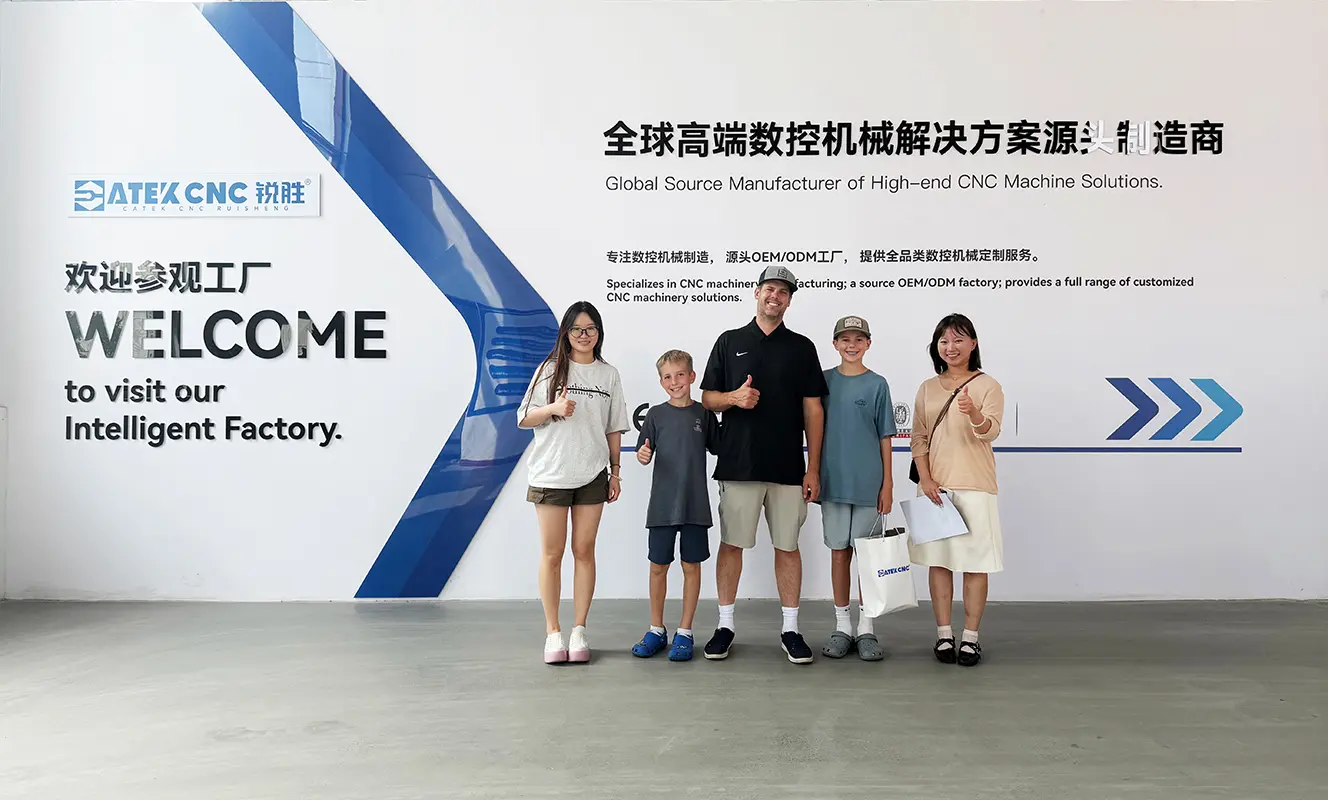
On August 11, 2026, a CNC machinery distributor from the United States visited CATEKCNC to gain an in-depth understanding of the manufacturing of CNC woodworking machinery, equipment configurations, and customization services. As a distributor who has been following the CNC machinery industry for a long time, the customer’s visit was aimed at finding CNC woodworking machines that are better suited to the U.S. market and offer differentiated competitive advantages.
During the visit and discussions, CATEKCNC focused on introducing the CK-1530-7T 7-in-1 CNC wood lathe to the customer. This multifunctional CNC wood lathe integrates turning, milling, engraving, planing, sanding, and other machining capabilities into one machine and is also equipped with an automatic loading and unloading system. The customer was impressed by the fact that one machine could handle such a wide range of woodworking applications.
At the same time, the customer designed the machine color according to his market positioning, and CATEKCNC provided customized production based on his requirements. Subsequently, both sides discussed the Spire CNC nesting machine, automated machining, and equipment customization.
Through this face-to-face product exchange, the customer gained a deeper understanding of the capabilities of a Chinese CNC manufacturer in equipment development, manufacturing, and customization. He also expressed strong confidence in future cooperation in the U.S. market.
I. U.S. Customer Visits CATEKCNC to Explore CNC Machinery
Compared with ordinary end users, distributors consider a machine from multiple perspectives before making a selection. A machine not only needs to meet processing requirements but also needs to have a clear market positioning, while the supplier must be able to continuously provide stable products and technical support. Therefore, before learning about the machines, the customer first visited CATEKCNC’s manufacturing facilities to gain a comprehensive understanding of the company’s CNC machine manufacturing capabilities. From equipment production and component configuration to complete machine assembly, the factory visit gave the customer a more direct understanding of the entire process from CNC machine production to delivery.
Compared with learning about CNC machinery only through product catalogs or videos, an on-site factory visit allows customers to see more details. For example, whether the overall machine structure is solid, how different components work together, whether the equipment assembly is standardized, and whether the manufacturer has the ability to make adjustments and provide customization according to different customer requirements. These are all important factors for a distributor when looking for a long-term CNC machine supplier.
During the visit, both sides also discussed the U.S. woodworking market. The customer shared some practical requirements of local woodworking businesses for CNC equipment, including processing efficiency, overall equipment utilization, and flexible switching between the processing of different products. Based on these requirements, the CATEKCNC team introduced the applications of different CNC woodworking machines and further demonstrated the CK-1530-7T multifunctional CNC wood lathe.
For the customer, this visit was not simply about “looking at machines,” but a comprehensive understanding of the products, factory, and cooperation approach. Especially for a distributor, what really matters is whether the manufacturer can continuously provide suitable equipment as market demands change, while maintaining good communication in terms of product configuration, exterior design, and technical support.
II. 7-in-1 CNC Wood Lathe Captures the Customer’s Attention
After visiting the production workshop, the customer came to the CATEKCNC equipment showroom. Based on the woodworking projects the customer typically encounters, the technical team introduced different types of CNC woodworking machines on site. When the customer saw the CK-1530-7T 7-in-1 CNC wood lathe, he quickly became interested in the machine.
What initially attracted the customer was not a particular specification, but the machine’s overall machining approach. The customer’s previous understanding of a CNC wood lathe was mainly focused on traditional applications such as wood turning and machining table legs or wooden columns. However, during the demonstration, he found that the CK-1530-7T could handle much more than these applications. From furniture components and stair parts to various customized wooden products, the range of applications covered by this CNC wood lathe showed the customer more possibilities. Especially for businesses that need to process different types of wooden components, a multifunctional CNC wood lathe with multiple machining capabilities can provide a more flexible production method than a traditional single-function wood lathe.
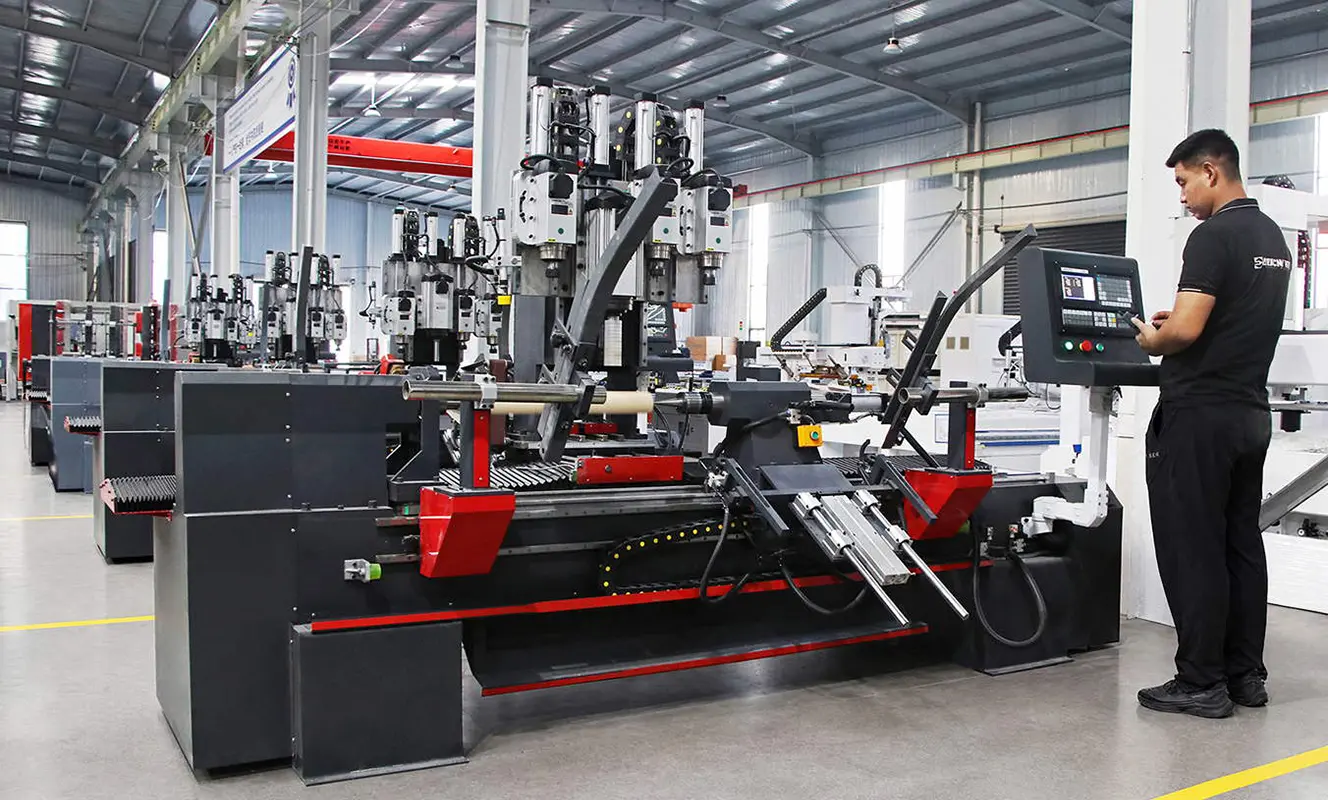
The technical team first demonstrated the turning function. After the wood material was positioned, the machine could complete basic cylindrical turning, curved surfaces, and different profiles. Then, through the machine’s other machining units, it could continue with milling, drilling, engraving, and surface finishing. In other words, after a wooden workpiece is basically formed, it does not necessarily need to be transferred to another machine for further processing. Instead, subsequent processes can be completed on the same multifunctional CNC wood lathe. This left a strong impression on the customer. For some complex wooden products, the real challenge is often not a single machining process, but the connection between different processes. When a workpiece is transferred from one machine to another, it needs to be repositioned and reclamped, and the machining reference may also need to be confirmed again. The more processes involved, the more manual operations are required, which can have a greater impact on the production process.
The customer also saw woodworking samples machined on the CNC wood lathe. The clearly defined profiles of table legs and wooden columns, together with the smooth transitions of the curved surfaces, gave the customer a more direct understanding of what the machine could actually produce. These finished samples made it easier for the customer to see the practical capabilities of the equipment.
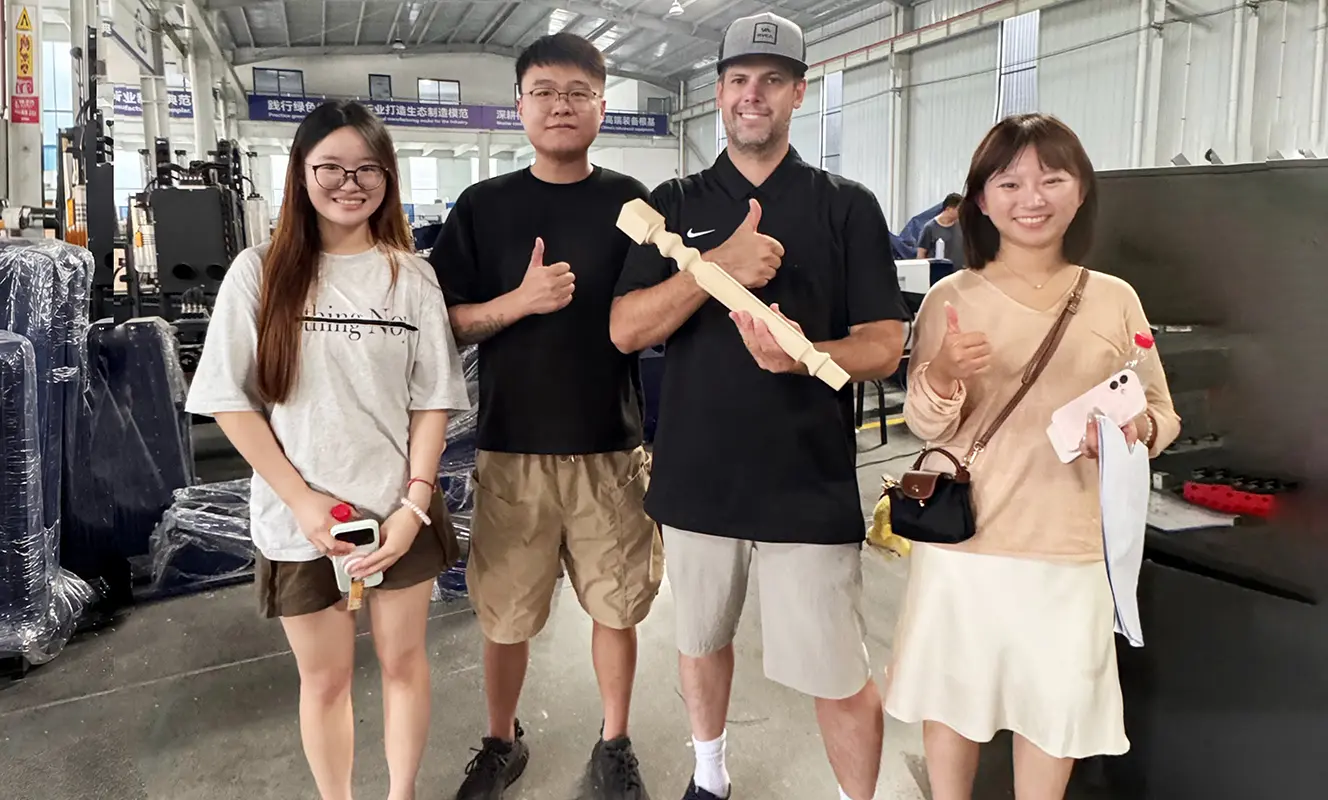
The design concept of the CK-1530-7T CNC wood lathe is to integrate these machining processes as much as possible. Different machining methods, including turning, milling, engraving, drilling, planing, and sanding, can be combined according to the product requirements, making the machine more suitable for complex wooden components and multi-process woodworking applications.
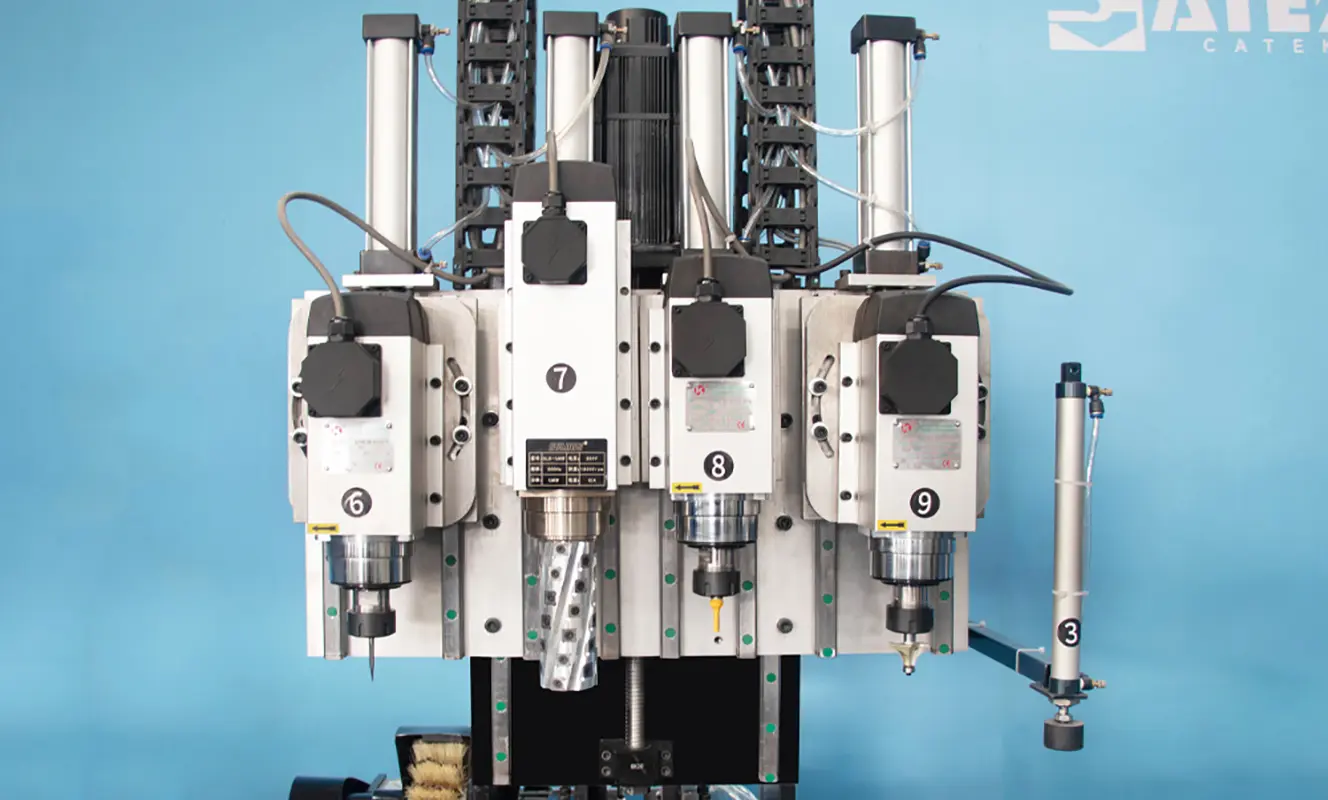
During the discussion, the customer also paid particular attention to the machine’s multi-spindle machining structure, with different machining units performing different tasks. For products such as table legs, chair legs, stair components, wooden columns, and furniture components, different machining steps can be arranged according to the actual drawings. This gradually helped the customer understand that the “7-in-1” concept of the CK-1530-7T is not simply a promotional term. Its greater value lies in the fact that one CNC machine can cover some of the machining processes that previously required several machines to work together.
III.Customer Further Explores the Spire CNC Nesting Machine
After learning about the CK-1530-7T and viewing the wood turning samples produced on site, the customer also became interested in other CNC woodworking machines. As a local CNC machinery distributor in the United States, he wanted to further understand whether CATEKCNC could provide different equipment solutions for various types of woodworking production, covering applications from solid wood processing to panel processing.
During the discussion, the CATEKCNC team introduced the Spire CNC nesting machine to the customer. Unlike the CNC wood lathe introduced earlier, which is mainly designed for three-dimensional workpieces such as round wood, table legs, and wooden columns, the Spire CNC nesting machine is primarily designed for the automated processing of cabinet panels, furniture panels, and other sheet materials. This difference in product positioning also gave the customer a more complete understanding of CATEKCNC’s CNC machinery product line.
1. Understanding the Practical Applications of CNC Nesting
The technical team introduced the customer to how a CNC nesting machine works, using cabinet and panel furniture production processes as examples.
For panel furniture production, a large sheet of material often needs to be processed into multiple parts with different shapes and dimensions. With traditional processing methods, cutting, drilling, grooving, and other operations may require different machines to work together, while the material needs to be moved repeatedly between different workstations.
In contrast, CNC nesting technology can arrange the parts on an entire sheet according to digital drawings and then continuously perform cutting, grooving, drilling, and other operations based on the programmed machining process. Proper nesting is important not only for processing efficiency but also for material utilization and overall production costs.
This is particularly important from a distributor’s perspective. When working with different furniture manufacturers, customers may have different priorities: some may place greater emphasis on processing speed, some may focus on material utilization, while others may want to reduce manual operations. By integrating multiple panel processing operations, a CNC nesting router can offer a wide range of applications in custom furniture, cabinets, panel furniture, and other woodworking production.
2. Customer Tests the Machine with His Own Drawings
After the introduction, the customer wanted to test the machine using his own product drawings. He then sent the cabinet design drawings he had prepared in advance to CATEKCNC, hoping to have the cabinet panels processed directly according to his design.
For CATEKCNC, this was also a valuable opportunity for on-site communication. Compared with standard samples prepared in advance, the customer’s own drawings were much closer to the real processing requirements he might encounter in the U.S. market in the future. After confirming the processing requirements and preparing the program based on the drawings, the technical team carried out the actual machining directly on the Spire CNC nesting machine.
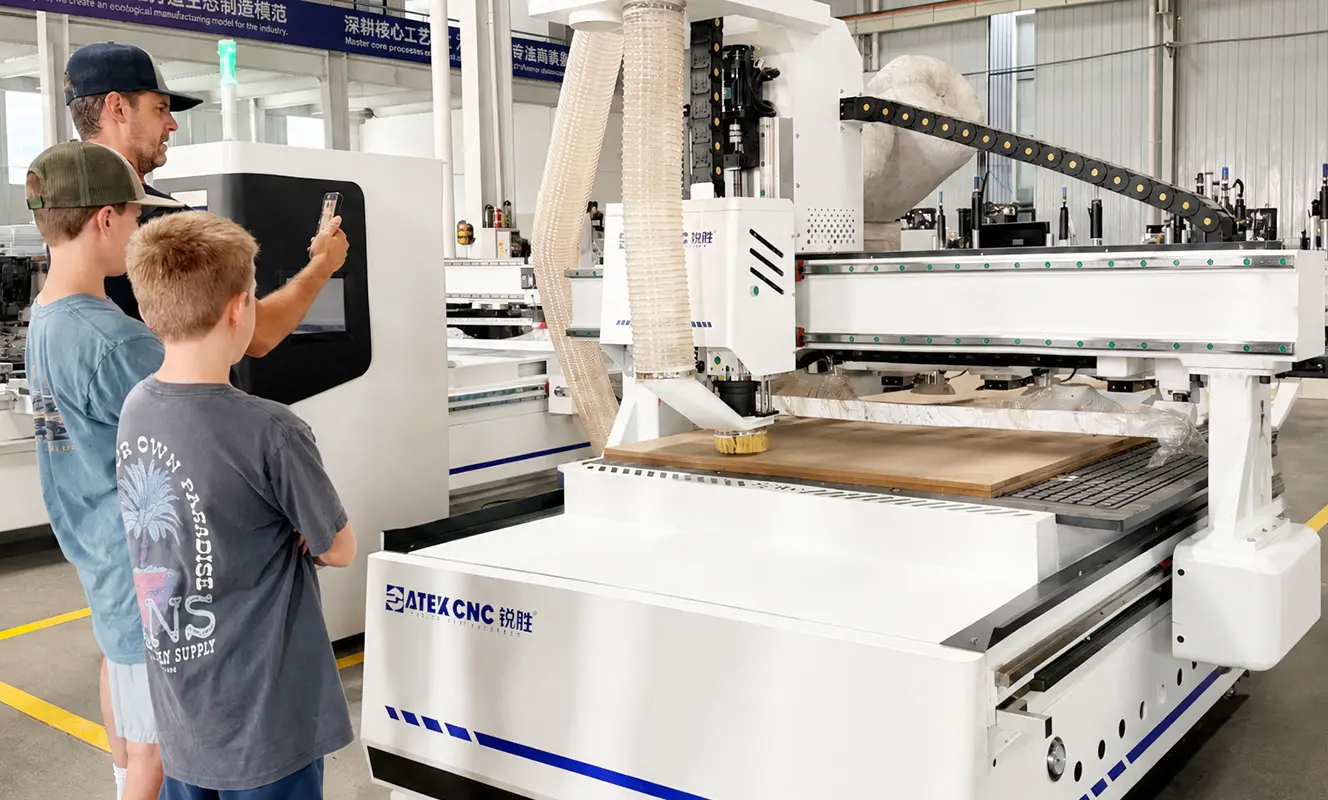
As the machine started running, the customer could clearly see the cabinet panels being processed from a full sheet of material into different components. The entire machining process ran smoothly, and the CNC nesting machine’s processing speed also left a strong impression on the customer.
This experience helped the customer further understand that the value of a CNC nesting machine is not simply to “cut the panels,” but to connect digital design drawings with actual production through digital machining. For furniture manufacturers that frequently need to process cabinets in different sizes and styles, this type of machining method can better support customized production.
From the solid wood processing demonstration of the CK-1530-7T to the cabinet panel processing on the Spire CNC nesting machine, the customer gradually gained a clearer understanding of the different applications of CATEKCNC’s CNC equipment. The former addresses the comprehensive processing needs of three-dimensional wooden workpieces, while the latter is more suitable for the digital processing of panel furniture and cabinet panels.
For an overseas distributor looking for a reliable CNC machine supplier, a product line covering different woodworking production scenarios also means being able to select the most suitable CNC woodworking solution according to the specific products and production methods of end customers, rather than being limited to a single type of equipment.
IV. Automation Brings Higher Production Efficiency
After learning about the multifunctional CNC wood lathe and Spire CNC router machine separately, the customer gained a deeper understanding of the automation design of both machines. Although the two machines are designed for different types of processing, they share one common feature: reducing repetitive manual operations through automation, making CNC machining more suitable for continuous production.
For the CK-1530-7T, the automatic loading and unloading system can reduce the need for operators to repeatedly handle and load or unload wood materials. Once the wood enters the machining area, the equipment can complete the corresponding processes according to the preset program and unload the finished workpiece, preparing for the processing of the next workpiece. For businesses that need to process products such as table legs, chair legs, and wooden columns in batches, this continuous processing method can reduce manual involvement and make the production rhythm more stable.
For cabinet panel processing, the Spire CNC nesting machine demonstrates another approach to automation. After the customer provided his own cabinet drawings, the machine could complete panel nesting and machining according to the digital machining program, processing a full sheet into multiple components with different shapes and dimensions. For custom furniture, cabinet, and panel furniture manufacturers, this digital production method can reduce manual measuring, marking, and repeated positioning, making the connection between design and actual production more direct.
Although the two machines have different applications, the customer could see one common change during the on-site demonstration:
From relying on manual labor to perform a large number of repetitive operations to using CNC equipment to achieve more continuous and consistent machining through digital programs.
For woodworking businesses, the value of this automation is not simply that it “makes machining faster.” As order volumes increase and product varieties expand, reducing repetitive manual operations allows employees to focus more on material preparation, quality inspection, and production management. At the same time, a standardized CNC machining process can also help maintain consistency between different production batches.
This was also a key point for the customer as a local U.S. distributor. When introducing CNC woodworking machines to woodworking businesses in the United States, he needs to explain not only what the machines can process, but also how the equipment can help customers improve production efficiency, reduce labor input, and adapt to both batch production and customized production.
Through this factory visit and actual machining experience, the customer saw that although the CK-1530-7T and Spire CNC nesting machine serve different woodworking applications, both are moving toward more automated and digitalized production methods. This also gave him a more complete understanding of CATEKCNC’s CNC woodworking solutions.
V. Why the Customer Sees Potential in the U.S. Market
As a local CNC machinery distributor in the United States, the customer’s interest in the equipment goes beyond the machines themselves. What he cares more about is what types of CNC equipment are more likely to be accepted by local woodworking businesses and whether a machine can truly solve their production challenges.
1. Growing Demand for Efficient Woodworking Solutions
In actual woodworking production, efficiency is not only about the cutting speed of the machine itself. Material handling, workpiece positioning, transitions between different processes, and repetitive manual operations can all affect overall production efficiency.
This is also one of the reasons why the customer believes that efficient CNC woodworking solutions have room to grow in the U.S. market. Whether it is the comprehensive processing of solid wood components with the CK-1530-7T or the digital processing of cabinet panels with the Spire CNC nesting machine, the two machines are designed for different applications but both help reduce unnecessary manual operations and make the production process more continuous.
For furniture manufacturers, cabinet manufacturers, and custom woodworking businesses that need to handle batch orders, whether a machine can help increase output per unit of time has become an increasingly important consideration when choosing a CNC machine. After seeing the actual machining process on site, the customer also gained a more direct understanding that the value of automated CNC equipment is not simply to replace manual labor, but to make the connection between design, machining, and production more efficient.
2. Serving a Broader Range of Woodworking Businesses
From the distributor’s perspective, another advantage is that CATEKCNC’s equipment is not limited to a single type of woodworking product.
The CK-1530-7T is more suitable for table legs, chair legs, wooden columns, stair components, and other three-dimensional wooden workpieces, while the Spire CNC nesting machine can be used for cabinet panels, furniture panels, and custom furniture components. This means that when working with different customers, the distributor can recommend different CNC woodworking machines according to their product types and production methods.
For example, a company mainly producing solid wood tables and chairs may focus more on complex curved surfaces and three-dimensional component processing, while a cabinet or custom furniture manufacturer may be more concerned with panel nesting, cutting efficiency, and quickly switching between different orders.
For a distributor, a CNC machinery product line that covers a wider range of applications also means broader customer coverage. It was from this perspective that the customer saw further opportunities to promote CATEKCNC’s products in the U.S. market.
3. Customization to Support Local Market Positioning
While learning about the equipment and the needs of the U.S. market, the customer also paid particular attention to CATEKCNC’s customization capabilities. For distributors, machines entering different markets may face different customers, brand positioning, and sales approaches. Therefore, a completely fixed standard configuration may not necessarily be suitable for every market.
During this visit, the customer designed the machine color himself. CATEKCNC made adjustments according to the design provided by the customer, allowing the machine to maintain its original structure and functions while presenting an appearance that better matched the customer’s market positioning. Although this may seem like simply a change in color, for a distributor, it is also part of product differentiation. Especially when selling multiple CNC woodworking machines in the local market, equipment with a distinctive appearance and recognizable brand identity can be more easily differentiated from standard products.
In addition to appearance customization, CATEKCNC can also discuss equipment configurations with customers according to different processing requirements. For example, different woodworking businesses have different product types and production processes. Some may focus more on three-dimensional solid wood processing, while others may require continuous processing of cabinet panels and furniture panels. Therefore, when choosing a CNC machine manufacturer, the ability to provide suitable configurations and solutions based on actual applications is also an important capability that distributors value. CATEKCNC can provide different customized CNC machine solutions based on the customer’s specific products, production methods, and target market.
The customer was satisfied with this flexible customization approach and further learned that CATEKCNC not only manufactures CNC machines, but can also provide OEM/ODM and customized CNC woodworking solutions based on the actual needs of overseas customers.
For distributors looking to establish their own product identity in the local market, this flexibility—from standard equipment to customized solutions—is also an important capability to consider when choosing a long-term CNC manufacturing partner.
VI. Building Confidence in Chinese CNC Manufacturing
During the visit, the customer first learned about CATEKCNC’s manufacturing environment, then viewed the machining samples produced by the CK-1530-7T and experienced the actual machining process of the Spire CNC nesting machine. In particular, after the customer provided his own cabinet panel drawings, CATEKCNC carried out on-site machining directly according to the actual requirements, allowing the customer to evaluate the equipment based on real machining results rather than relying only on product information and promotional materials.
From machine operation to the completion of the machining process, the customer was able to closely observe the equipment’s working condition, processing speed, and final results. For a CNC distributor, this kind of on-site experience is much more convincing than simply looking at pictures or specifications, and it also gave him a more direct understanding of CATEKCNC’s equipment quality and technical capabilities.
At the same time, through discussions, the customer also learned more about CATEKCNC’s approach to working with overseas markets. Whether it involved equipment selection, product configuration, or the simple customization of the machine’s exterior in this case, the factory was able to communicate and make adjustments according to the customer’s requirements. For a distributor, this means that when facing different requirements from end customers in the U.S. market in the future, support can be provided directly from the manufacturing side.
This visit also expanded the customer’s understanding of “Made in China” beyond the products themselves to include manufacturing capabilities and cooperation capabilities. What he saw was not simply a manufacturer capable of supplying CNC wood lathes and CNC nesting machines, but a CNC manufacturer that can participate in product development, on-site testing, and communication around market requirements.
Through the factory visit, product demonstrations, and on-site machining, the customer gained greater confidence in CATEKCNC’s manufacturing capabilities and CNC woodworking solutions, creating a solid foundation for further discussions about cooperation in the U.S. market.
VII. Looking Forward to Long-Term Cooperation in the U.S. Market
This visit by the U.S. customer gave both sides a more comprehensive understanding of each other through product demonstrations, on-site machining, and in-depth discussions. The customer was deeply impressed by CATEKCNC’s CNC woodworking machinery, machining capabilities, and customization services, and also saw the potential of these CNC equipment solutions in the U.S. market. In the future, CATEKCNC will continue to provide overseas customers with reliable CNC equipment and flexible CNC woodworking solutions, and looks forward to working with U.S. partners to explore more opportunities in the market.