


{{goods.model}}
CNC Wood Lathe Recommendation: Why the 7-in-1 Wood Lathe Is a Market Bestseller
In the woodworking industry, efficiency, precision, and versatility are the keys to success. Whether you run a small workshop, a custom furniture shop, or a large-scale production facility, choosing the right CNC wood lathe can significantly improve production efficiency, product quality, and profitability.
The 7-in-1 multifunctional CNC wood lathe has become a true market bestseller, integrating seven basic machining functions into a single high-precision machine. This machine combines turning, drilling, slotting, milling, surface machining, chamfering, flat engraving, and 3D engraving capabilities, allowing users to complete a wide range of woodworking tasks without the need for multiple standalone machines.
In this article, we will delve into the multifunctional woodworking lathe, covering technical specifications, detailed woodworking case studies, and complete workflows, to explain why this CNC wood lathe will become a market bestseller in 2026.
I. What is a 7-in-1 Multifunctional CNC Wood Lathe?
The 7-in-1 multifunctional CNC wood lathe is an advanced woodworking machine capable of performing multiple machining operations in a single setup. Unlike traditional woodworking lathes, which are limited to simple turning, this multifunctional CNC woodworking lathe integrates turning, milling, drilling, sanding, engraving, and 3D carving into a single machine.
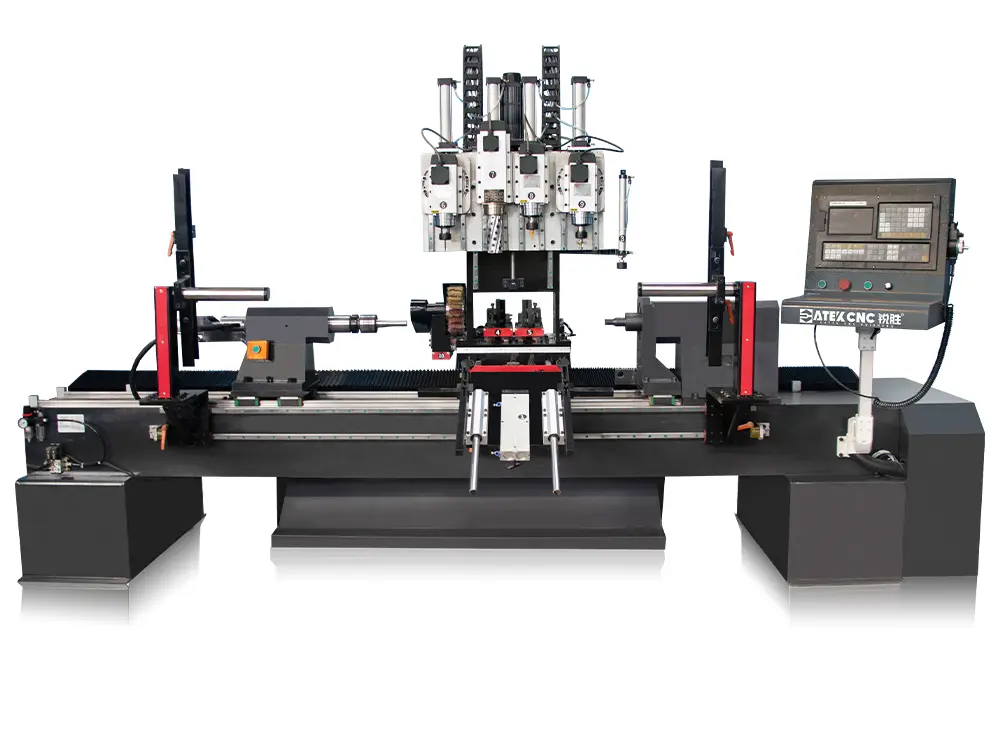
This equipment is widely used in furniture manufacturing, stair production, decorative woodworking, and custom woodworking shops. By integrating multiple machining processes into a single unit, the multifunctional CNC wood lathe significantly improves efficiency, reduces labor costs, and ensures consistent machining accuracy.
In traditional woodworking production, different processes require different machines. A typical woodworking shop might need a lathe, drill press, milling machine, and sander to complete the machining of a single furniture component. Each process requires manual repositioning, which increases production time and reduces precision.
With a 7-in-1 CNC wood lathe, all these operations can be completed in a single setup, enabling manufacturers to produce complex wooden parts faster and with greater precision. For this reason, multifunctional CNC woodworking lathes are becoming increasingly popular in modern woodworking factories.
1. Core Concept
“7-in-1” refers to a machine’s ability to perform multiple machining functions without changing tools. Depending on the configuration, a professional multifunctional CNC wood lathe can integrate the following machining processes:
- Wood turning
- Milling and slotting
- Drilling and tapping
- Planing or surface finishing
- Sanding and polishing
- Flat engraving
- 3D engraving or multi-axis machining
By combining these functions, a single multifunctional wood lathe can replace several traditional machines, saving space and improving production efficiency. This design is particularly important for workshops that need to produce various types of furniture components, such as table legs, chair legs, stair balusters, handrails, and decorative columns.
2. CNC Systems and Automation
Modern CNC wood lathes use digital control systems to manage all machining operations. CATEKCNC provides free PowerMill post-processing files, enabling the machine to perform machining with high precision automatically.
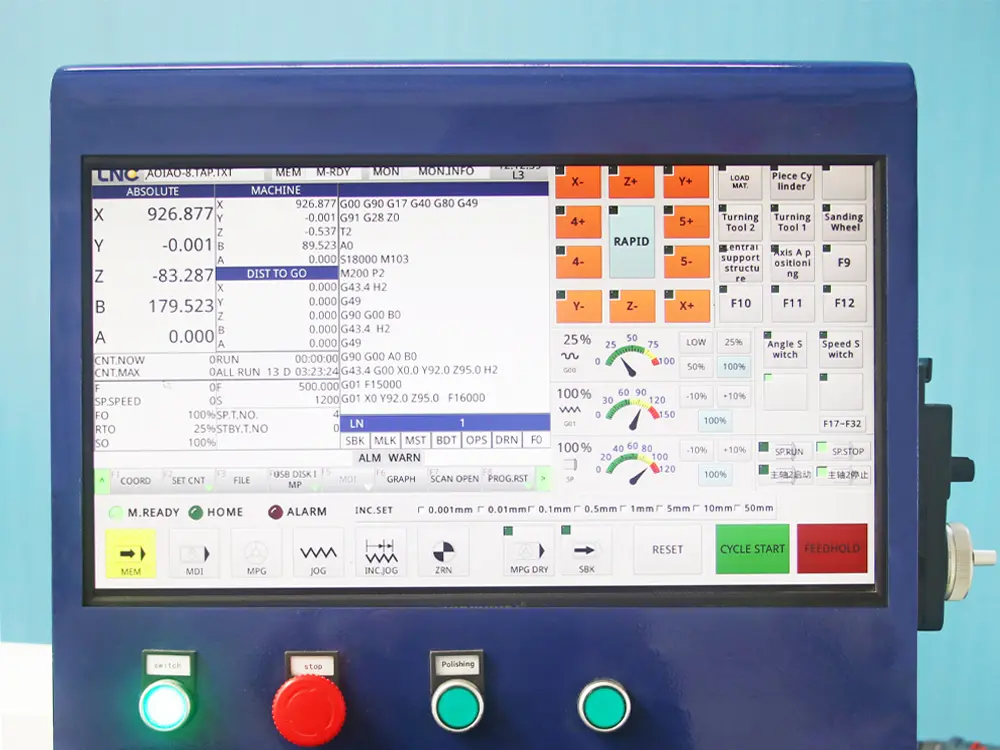
Compared to manual woodworking machinery, CNC machines offer the following advantages:
- Higher accuracy and repeatability
- Faster production speeds
- Reduced reliance on operator skill
- Reduced material waste
- Consistent quality in batch production
Many 7-in-1 machines also support automatic loading and unloading, making them an ideal choice for continuous production in furniture factories. Additionally, CATEKCNC woodworking lathes support 4-axis or 5-axis machining, enabling the machine to process complex curves, multi-angle drilling, and fine engraving without repositioning the workpiece.
II. Detailed Explanation of the 7-in-1 Functions
To understand why the 7-in-1 CNC wood lathe is so popular, it is essential to understand each function and its applications in actual woodworking production.
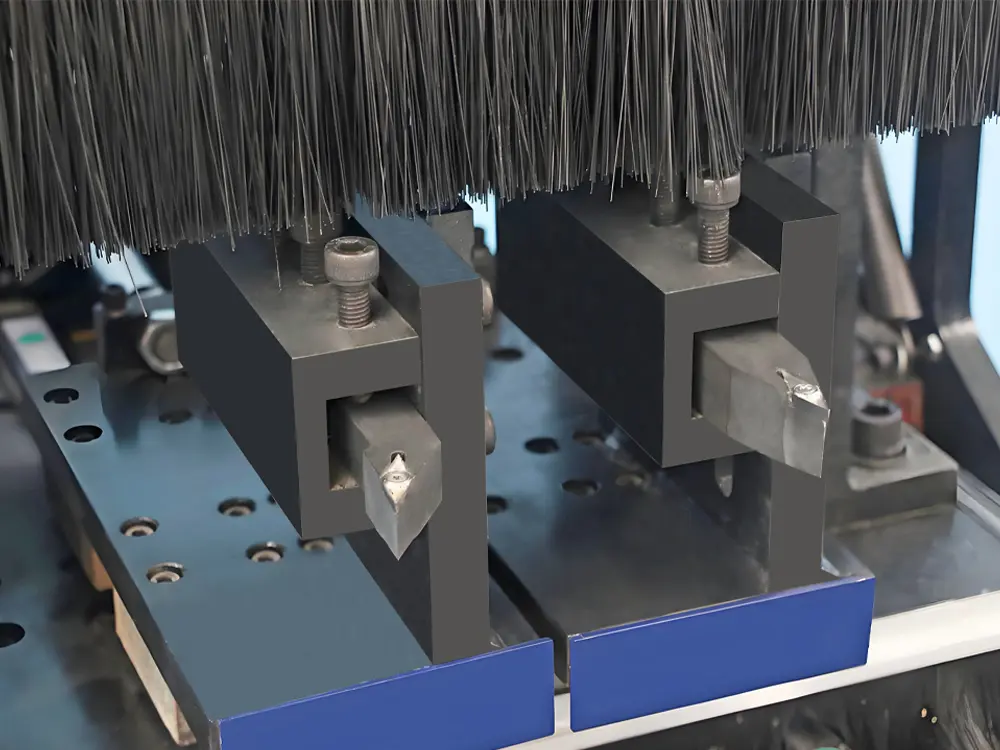
1. Turning Function
Turning is the most basic operation of a woodworking lathe, used to machine cylindrical or circular parts. With the help of CNC technology, the machine can automatically produce precise curves, tapers, and various decorative shapes.
Common applications include:
- Table and chair legs
- Stair railings
- Wooden posts
- Handrails
Compared to manual lathes, CNC wood lathes ensure consistent dimensions and shapes for every part, which is crucial for mass production.
2. Milling and Grooving Capabilities
The milling spindle enables CNC wood lathes to machine grooves, channels, and flat surfaces. This capability is commonly used to produce furniture components that require assembly holes, joints, or decorative grooves.
Typical applications include:
- Cutting grooves into chair legs
- Creating mortise-and-tenon joints
- Surface planing
- Edge profiling
Equipped with multiple functional spindles, milling operations can be performed without removing the workpiece.
3. Drilling Capabilities
Almost all furniture components require drilling, and a multi-functional CNC wood lathe can perform high-precision drilling according to a program. Since drilling is performed automatically based on the program, it ensures that the hole positions on the parts are consistent.
This is particularly useful in the following scenarios:
- Assembly holes for chairs
- Table frame connections
- Stair components
- Hardware mounting holes
4. Planing and Surface Machining Capabilities
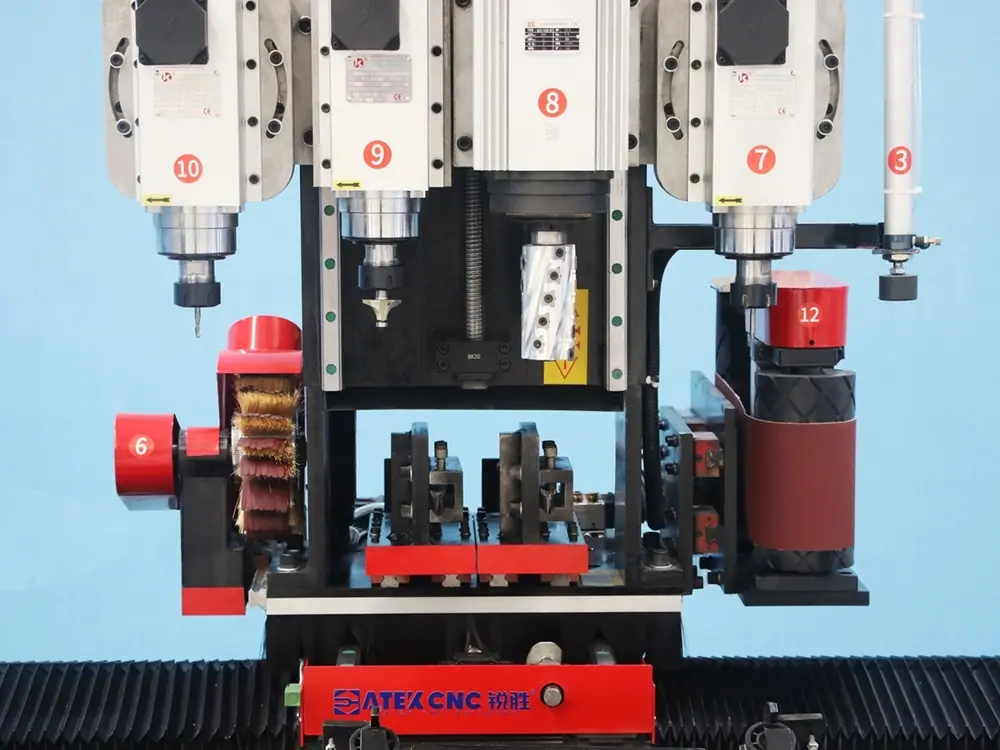
The CATEKCNC 7-in-1 CNC Wood Lathe is equipped with a powerful planing spindle and a surface machining spindle, enabling rapid surface machining or the removal of excess material. The high-power spindle ensures stable cutting even on hardwood.
Applications include:
- Flattening boards
- Preparing raw materials
- Surface finishing prior to carving
- High-speed roughing
5. Sanding and Polishing Functions
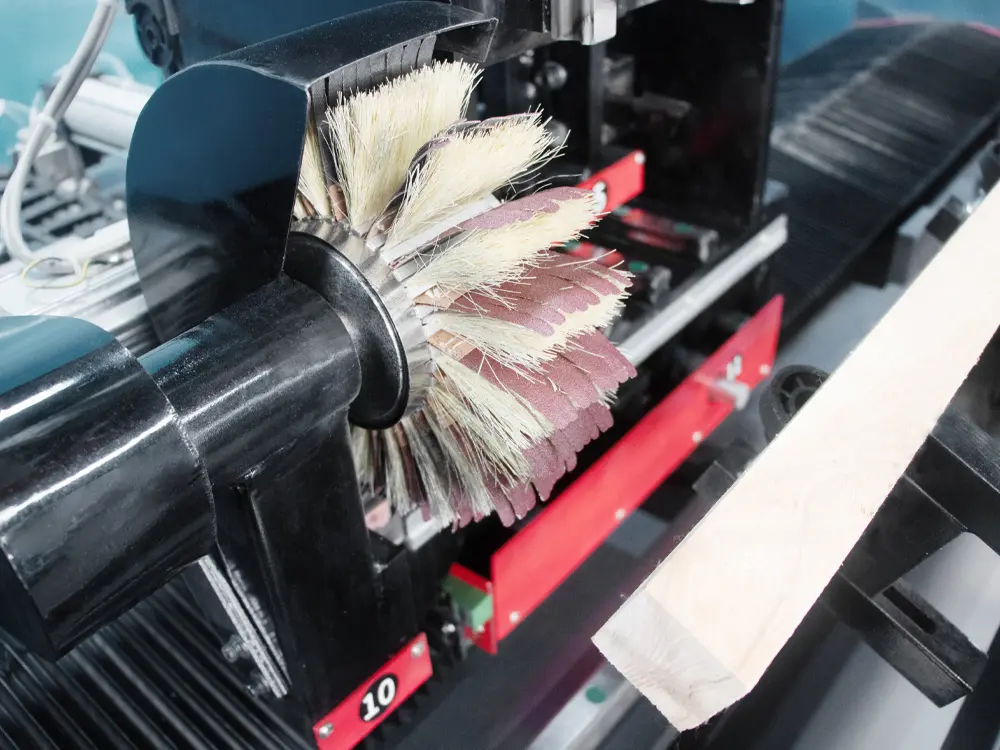
Surface finishing is a critical step in woodworking production. The sanding unit on a multifunctional CNC wood lathe can automatically sand workpieces, reducing manual labor.
6. Surface Carving Capabilities
The machine can carve decorative patterns onto the surface of wood, and complex designs can be reproduced repeatedly through CNC programming.
Common applications include:
- Decorative panels
- Furniture ornaments
- Door frames
- Carved panels
Using the 7-in-1 CNC wood lathe for automated processing adds value to furniture products without increasing labor costs.
7. 3D Carving Capabilities
Advanced CNC wood lathes support multi-axis machining, such as 4-axis or 5-axis control. The machine’s rotating axes move along curved paths, enabling the cutting of complex shapes from various angles.
Main Applications:
- Curved handrails
- Intricate stair railings
- Carved furniture components
- Artistic woodworking
- Custom designs
III. Suitable Woodworking Applications for a 7-in-1 CNC Wood Lathe
One of the main reasons why the 7-in-1 multifunctional CNC wood lathe has become increasingly popular in recent years is its ability to adapt to different production needs.Below are some of the most common machining scenarios where a woodworking CNC machine shows clear advantages over traditional equipment.
1.Furniture Manufacturing and Mass Production of Wooden Parts
Furniture manufacturing is one of the primary applications for CNC wood lathes. Furniture factories produce a wide variety of components, such as table legs, chair legs, sofa legs, bedposts, and wooden columns. These components require precise turning, drilling, and smooth surface finishing, and sometimes also involve the machining of decorative grooves or patterns. If these operations were performed using traditional woodworking lathes, the workpiece would need to be moved to another machine for processing, which would only increase production time, and repeated clamping often leads to dimensional errors.
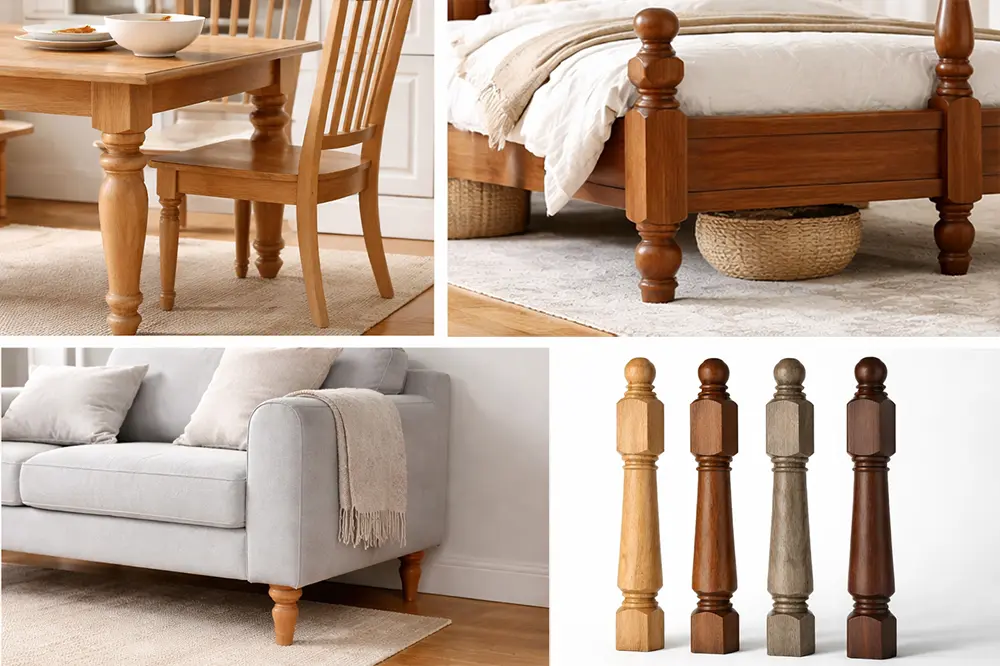
A multifunctional wood lathe machine for furniture allows the entire process to be completed in one clamping. The turning tool shapes the basic form, the milling spindle cuts grooves, the drilling unit creates assembly holes, and the sanding device finishes the surface automatically. Because all operations are controlled by the CNC system, every piece has the same size and shape, which is extremely important for furniture assembly.
For factories that produce hundreds of parts daily, this automatic wood lathe can significantly reduce labor costs and increase output. Instead of relying on experienced workers to operate multiple machines, a single operator can control the entire machining process. This not only improves production efficiency but also reduces the risk of errors that often occur in manual production.
As furniture designs become increasingly complex, manufacturers also need machines capable of processing curved surfaces and decorative details. In this case, a multifunctional CNC furniture lathe is the optimal choice, as it can perform turning, milling, and engraving on a single machine without sacrificing speed or precision.
2.Stair Balusters, Columns, and Architectural Wood Components
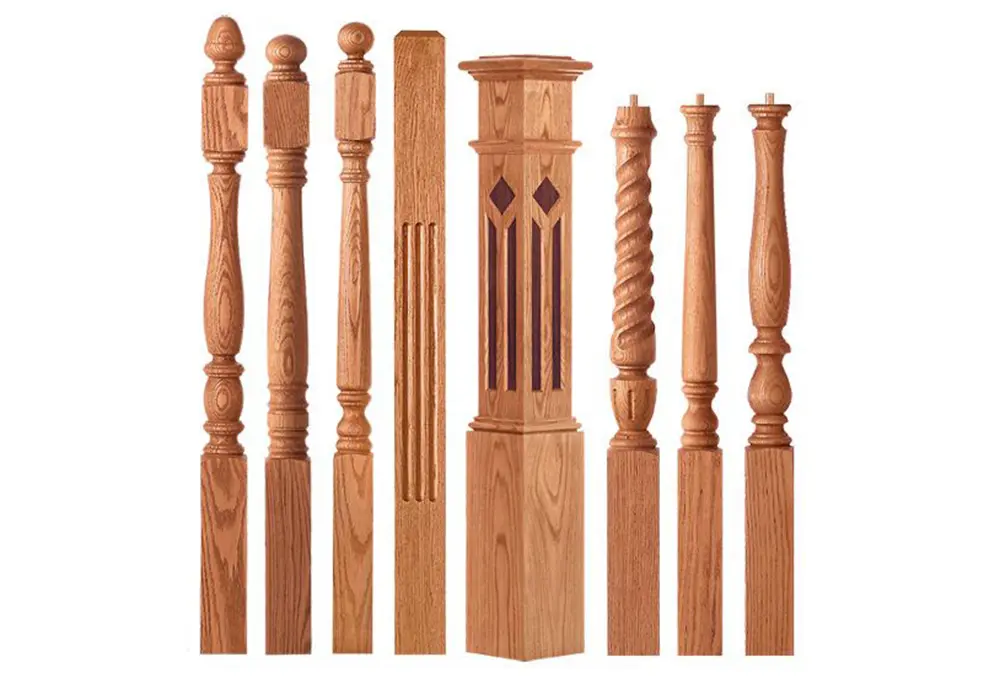
Another common application of CNC wood lathe is the production of stair components and architectural woodwork. Stair balusters, handrail posts, and decorative columns all require precise turning and meticulous machining. If the dimensions of the balusters vary even slightly, installation becomes difficult, and the final product may lack refinement. Wood turning machine with CNC control, however, ensure that every component is produced according to the same program, thereby completely resolving this issue.
Furthermore, many modern staircase designs incorporate decorative patterns or curved shapes that are difficult to machine using traditional equipment. More advanced woodworking CNC machine can easily handle these tasks, enabling manufacturers to produce more complex designs without increasing production time.
3.Decorative Woodworking and Custom Furniture Production
In high-end furniture and interior decoration, customers often require unique designs rather than standard parts. Decorative columns, carved furniture legs, curved armrests, and artistic wooden components all require more advanced machining capability.
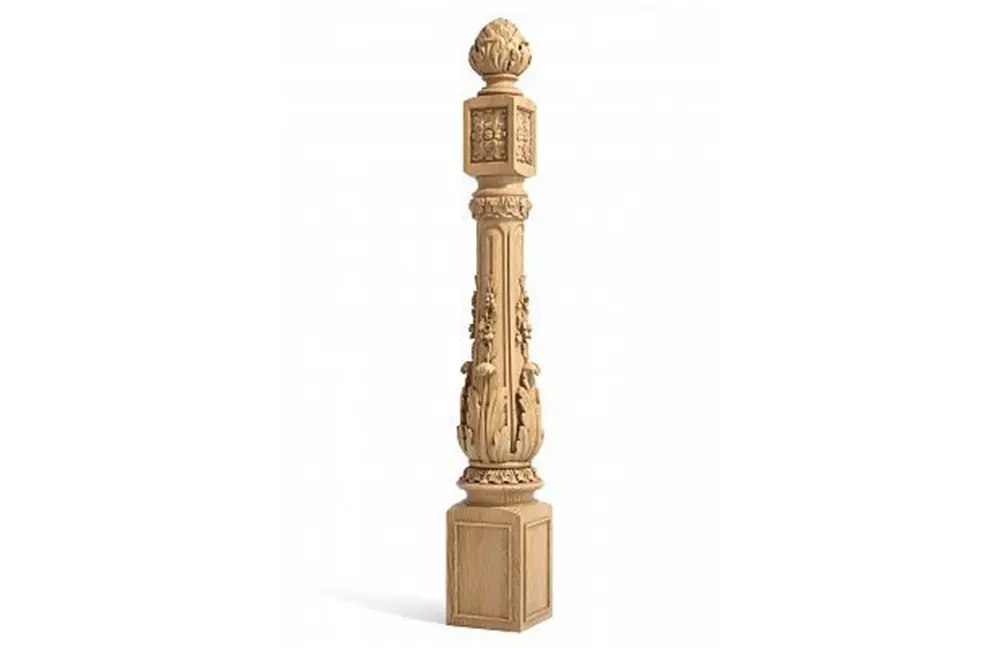
A multifunctional CNC wood lathe makes it possible to produce complex designs with high precision. The CNC system can control the cutting tools to create curves, grooves, and engraved patterns exactly according to the drawing. This allows workshops to accept custom orders without worrying about inconsistent quality or long production times.
For companies that specialize in custom furniture, a woodworking CNC machine is not only a tool, but also a way to increase business opportunities. When customers know that the workshop can produce complex parts with high accuracy, they are more willing to place high-value orders.
Another advantage of using a CNC wood lathe in decorative woodworking is repeatability. Even if the design is complicated, the machine can produce the same part again and again without variation. This is especially important for projects where many identical decorative elements are required, such as hotel furniture, luxury villas, or large interior decoration projects.
4.4-Axis and 5-Axis 7-in-1 CNC Wood Lathe for Different Production Needs
To meet the requirements of different woodworking factories, the 7-in-1 multifunctional CNC wood lathe is available in both 4-axis and 5-axis configurations. Although both machines can complete turning, drilling, milling, sanding, and carving in one setup, the difference in axis structure, spindle configuration, and automation level makes each model suitable for different production scenarios. Choosing the correct CNC wood lathe is critical for improving efficiency, reducing labor cost, and ensuring machining accuracy.
The standard 4-axis model is designed for high-efficiency batch production of furniture parts, stair components, and other cylindrical wooden products, while the 5-axis model is built for complex shapes, multi-angle machining, and high-end custom woodworking.
1) 4-Axis 7-in-1 CNC Wood Lathe for Furniture and Stair Parts Production
The 4-axis multifunctional CNC wood lathe is one of the most widely used machines in furniture factories because it provides the best balance between cost and productivity. This machine can complete turning, milling, drilling, planing, sanding, and engraving without moving the workpiece, which is ideal for batch production of table legs, chair legs, sofa legs, stair balusters, wooden columns, and other standard components.
The multifunctional CNC wood lathe typically supports a machining size around 1500x300 mm (other sizes can be customized), which covers most furniture and staircase parts.It features a heavy-duty double-bed structure, which enhances stability during high-speed turning and ensures the machine remains stable even when machining hardwood. The drive spindle uses a 4KW high-torque servo motor with speed up to 6000 rpm, providing enough power for continuous turning operations.
Designed for milling, carving, and drilling, the CNC wood lathe CK-1530-7T is equipped with multiple high-speed spindles, typically operating at speeds of up to 18,000 RPM, enabling it to perform grooving, slotting, and carving within a single turning cycle. The integrated sanding unit, controlled by an independent servo system, automatically polishes surfaces, thereby reducing manual labor and improving consistency in mass production.
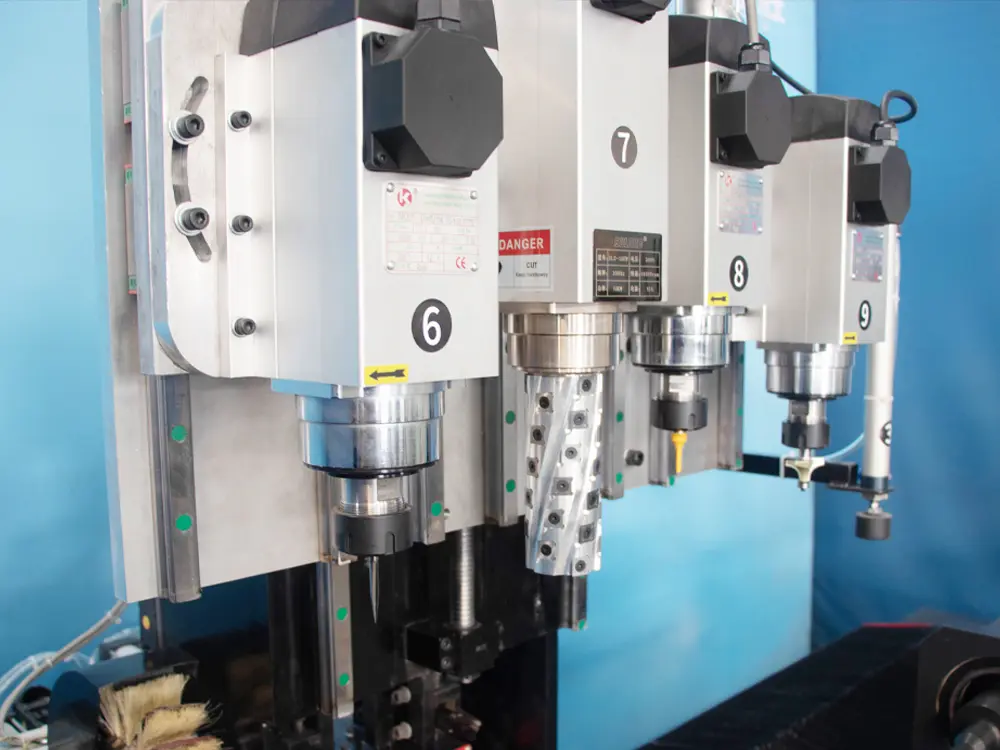
Because the CK-1530-7T features a four-axis configuration—comprising three linear axes (X, Y, and Z) and one rotary axis—it is highly efficient for parts that primarily require rotary machining. This makes the machine an ideal CNC lathe for furniture manufacturers, who need to produce large quantities of similar parts on a daily basis. With its automatic loading and unloading system, a single operator can manage multiple machines simultaneously, thereby significantly reducing labor costs in modern woodworking factories.
For most factories producing standard furniture components, a 4-axis woodworking lathe equipped with a CNC system offers sufficient flexibility and speed, making it the most cost-effective solution.
2) 5-Axis 7-in-1 CNC Wood Lathe for Complex Shapes and High-End Woodworking
When the production requires curved surfaces, multi-direction drilling, or irregular shapes, a standard 4-axis machine may not be enough. In these situations, a 5-axis CNC wood lathe becomes the better choice because it allows the tool to move from different angles and reach positions that are impossible for traditional machines.
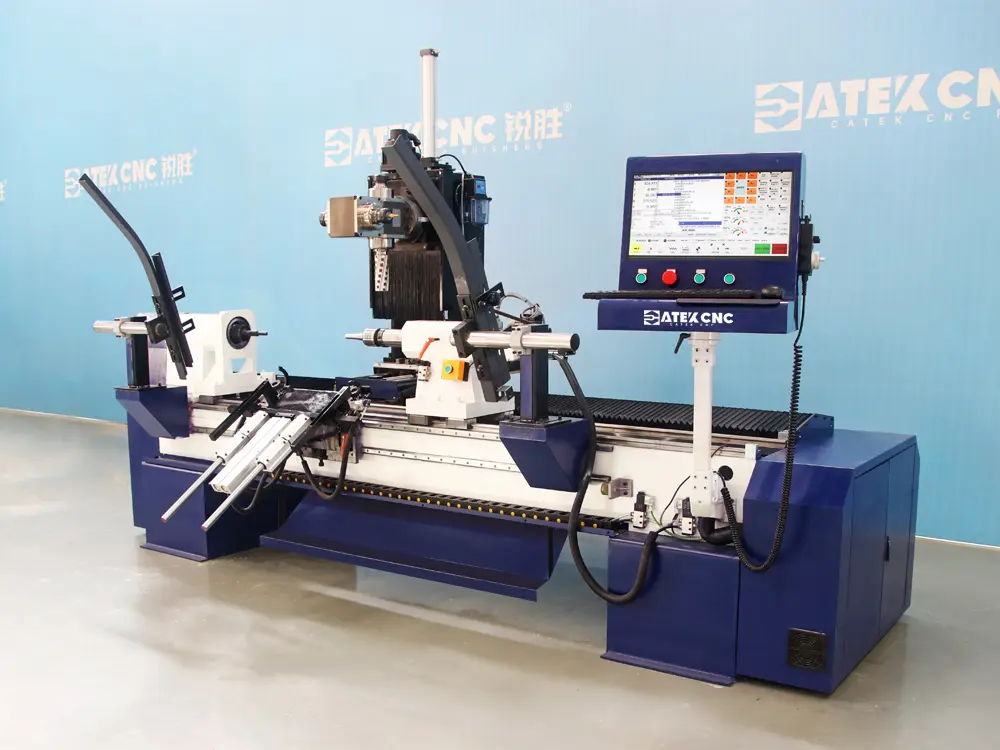
The 5-axis CNC wood lathe adds an additional rotary axis to the system, forming a structure of three linear axes (X/Y/Z) plus two rotary axes (A+B). This allows the spindle to tilt up to ±90°, so the tool can machine inclined surfaces, side faces, and complex curves without repositioning the workpiece. This greatly improves machining accuracy and eliminates errors caused by repeated clamping.
The 5-axis multifunctional CNC wood lathe is equipped with high-power multi-tool spindles, such as a four-tool high-speed spindle with a power output of up to 7.5 kW and a speed of up to 18,000 rpm, capable of holding multiple tools simultaneously. During the machining process, the spindle automatically switches tools or adjusts angles according to the program, completing operations such as turning, carving, drilling, and milling in a single machining cycle.
To ensure stability during complex machining processes, the machine tool features a reinforced cast-iron bed, precision ball screws, and high-power servo motors. The linear axes are driven by 1500W servo motors, while the rotary axes utilize independent servo drives to achieve precise positioning. Repeatability accuracy reaches approximately ±0.02 mm, which is crucial for high-end furniture and decorative woodworking.
For workshops that produce high-value products or fulfill custom orders, a 5-axis 7-in-1 CNC wood lathe enables the creation of more complex designs without increasing production time. This not only improves product quality but also boosts profit margins per unit, which is why an increasing number of professional woodworking shops are upgrading to 5-axis CNC woodturning lathes.
3) How to Choose Between 4-Axis and 5-Axis CNC Wood Lathe
In actual production, the choice depends on the type of machining you perform.
If your factory primarily produces standard furniture components, the CK-1530-7T 4-axis CNC wood lathe offers the best value for money.
If your business involves complex shapes, curved surfaces, or custom woodworking, the CK-1530-7T-5AXIS 5-axis machine offers greater flexibility and higher machining quality.
Understanding these differences helps manufacturers select the right multifunctional CNC wood lathe for their production lines, thereby ensuring efficiency and a long-term return on investment.
IV. Advantages Over Traditional Woodworking Lathes
Traditional woodworking lathes feature a simple design and low cost, making them widely used in woodworking shops. However, today’s modern factories require more than just a single machining method. CATEKCNC provides many furniture manufacturers with cost-effective CNC wood lathes to enhance production efficiency and precision.
Multifunctional CNC wood lathes are not merely an upgrade of traditional woodworking lathes, but a completely different type of CNC woodworking machine tool capable of performing a variety of machining operations while ensuring consistent quality.
1. Higher precision and more consistent quality
The biggest issue with traditional woodworking lathes is that the quality of the final product depends on the operator’s skill. Even experienced workers may produce parts with slight dimensional variations during turning, which can lead to problems during assembly.
CNC wood lathes utilize a digital control system to program the movement of cutting tools. Once parameters are set, the machine can produce hundreds of identical parts. Because the CNC system ensures repeatable positioning, it guarantees the precision and quality of every part.
2. Higher Production Efficiency
Another major limitation of traditional lathes is low production efficiency. Manual turning requires the operator to control the cutting tool by hand, and each part must be machined step by step. If drilling, slotting, or sanding is required, the workpiece usually needs to be moved to another machine. This process is time-consuming and increases labor costs.
A 7-in-1 multifunctional CNC wood lathe can perform turning, milling, drilling, engraving, and sanding in a single setup. Operators simply load the workpiece and start the program, and the machine automatically completes the entire machining cycle. This significantly reduces production time and allows a single worker to operate multiple machines simultaneously.
3. Ability to Machine Complex Shapes
Traditional lathes are primarily used for machining simple cylindrical workpieces. If a product requires curved surfaces, multi-angle drilling, or engraved patterns, the process becomes extremely difficult and inefficient. In some cases, it may even be impossible to achieve the desired shape using a standard lathe.
CNC wood lathes, particularly four-axis or 5-axis models, can machine more complex parts. With CNC technology, cutting tools can move along multiple axes, enabling the machine to automatically produce grooves, notches, curves, and decorative patterns.
4. Lower Labor Costs
In traditional woodworking shops, production relies heavily on experienced workers. Skilled machine operators are hard to find, and training new workers takes time. In addition, manual machining is physically demanding, and productivity may decline after long hours of work.
CNC woodworking machines solve this problem by automating most operations. Operators need only set up the program and monitor the machine, so the skill requirements are significantly reduced.
5. One Machine, Multiple Functions
Traditional lathes are limited to turning operations, whereas the 7-in-1 CNC wood lathe integrates multiple functions—including turning, drilling, milling, grooving, sanding, and carving—into a single machine. Since all processes are completed in a single setup, machining accuracy is higher and production time is shorter.
For small workshops, this means that a single multifunctional CNC wood lathe can replace several standalone machines, thereby saving space and reducing investment costs.
V. Customer Case Studies
Many customers who have used CATEKCNC CNC wood lathes have shared their experiences and samples of the products they’ve machined, highlighting how these machines have resolved their issues with low production efficiency and inconsistent quality.
1. Case 1—Milling Grooves and Machining Structural Components at a Chair Factory
A chair manufacturing plant needed to produce a large number of wooden chair frames. These components were not only round parts but also structural elements that required precise slotting for assembly. The position and dimensions of the slots had to be extremely accurate; otherwise, the chairs would be loose once assembled.
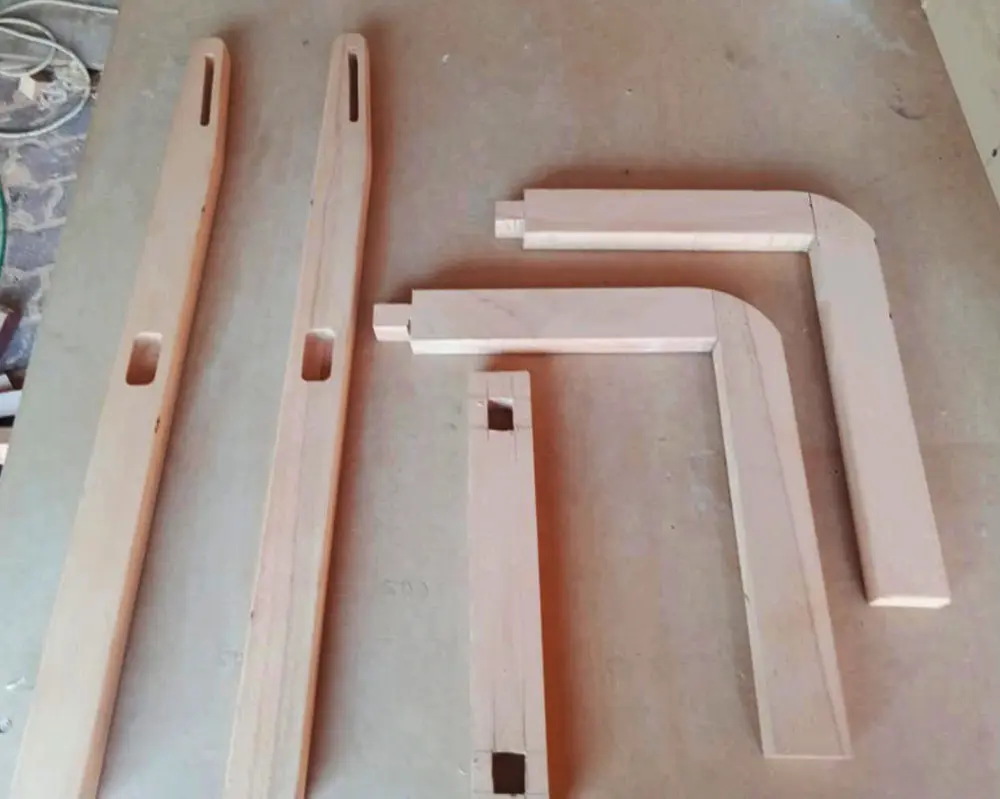
After upgrading to a 7-in-1 CNC wood lathe, the factory can now complete turning, drilling, and slotting operations in a single setup. The CNC system automatically controls the toolpath, ensuring that the dimensions and positions of every slot are perfectly consistent. The machine first turns the parts into shape, then switches to the milling spindle for slotting.
According to customer feedback, the greatest improvements lie in stability and efficiency. A single operator can continuously operate the fully automatic CNC wood lathe, significantly increasing daily output while reducing the number of workers. The factory also reported that assembly has become much easier because all parts are dimensionally consistent.
For furniture factories producing chairs, tables, or cabinets, this versatile CNC woodworking lathe is particularly useful, as it can machine both round parts and flat structural components on the same machine.
2. Case 2—Custom Furniture: Manufacturing Curved Table Legs
A custom furniture workshop specializes in crafting high-end wooden tables, most of which feature curved legs with distinctive designs, similar to those shown in the sample images. These components require smooth curves and precise symmetry, which are difficult to achieve using a manual lathe.
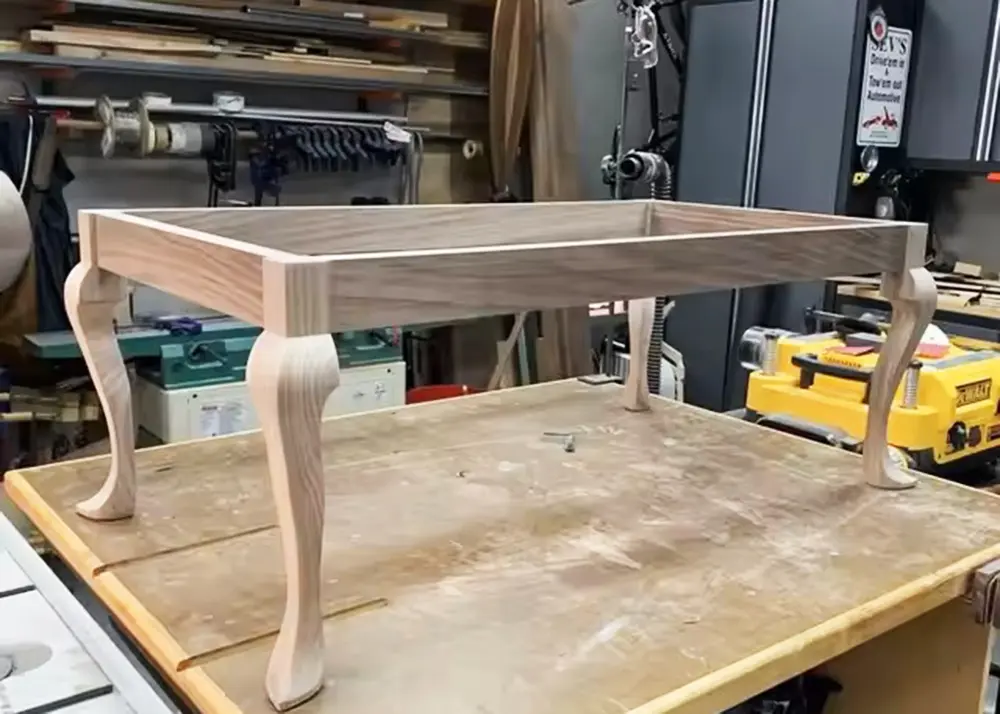
With this new multifunctional CNC wood lathe, operators simply load the material and run the program, and the machine automatically completes turning, contour cutting, and sanding in a single cycle. All four table legs can be machined to an identical shape, significantly improving product quality.
Customers report that since adopting the 5-axis CNC wood lathe, production time for a set of table legs has been reduced, and the surface finish is far superior to that of hand-crafted pieces. More importantly, the workshop can now take on more complex custom orders, thereby increasing profits per project.
VI. Purchasing Recommendations
When planning to purchase a CNC woodworking lathe, the most common question is which model best suits your production needs. Before selecting a machine, we recommend confirming the following:
- Maximum workpiece dimensions
- Types of products to be manufactured
- Required functions
- Axis configuration
- Spindle power
- After-sales support
A reliable supplier should recommend a suitable CNC wood lathe based on your actual production needs. If you have further questions about the machine, the CATEKCNC technical team is always available to provide professional answers.
VII. Conclusion
The 7-in-1 Multifunctional CNC Wood Lathe integrates seven core functions into a single machine, delivering exceptional versatility, precision, and efficiency. Whether you run a small workshop, a custom furniture studio, or a large manufacturing facility, this CNC wood lathe can significantly boost production efficiency while reducing labor costs.
Upgrade your woodworking workflow with the CK-1530-7T and experience the integrated machining capabilities of a CNC wood lathe.