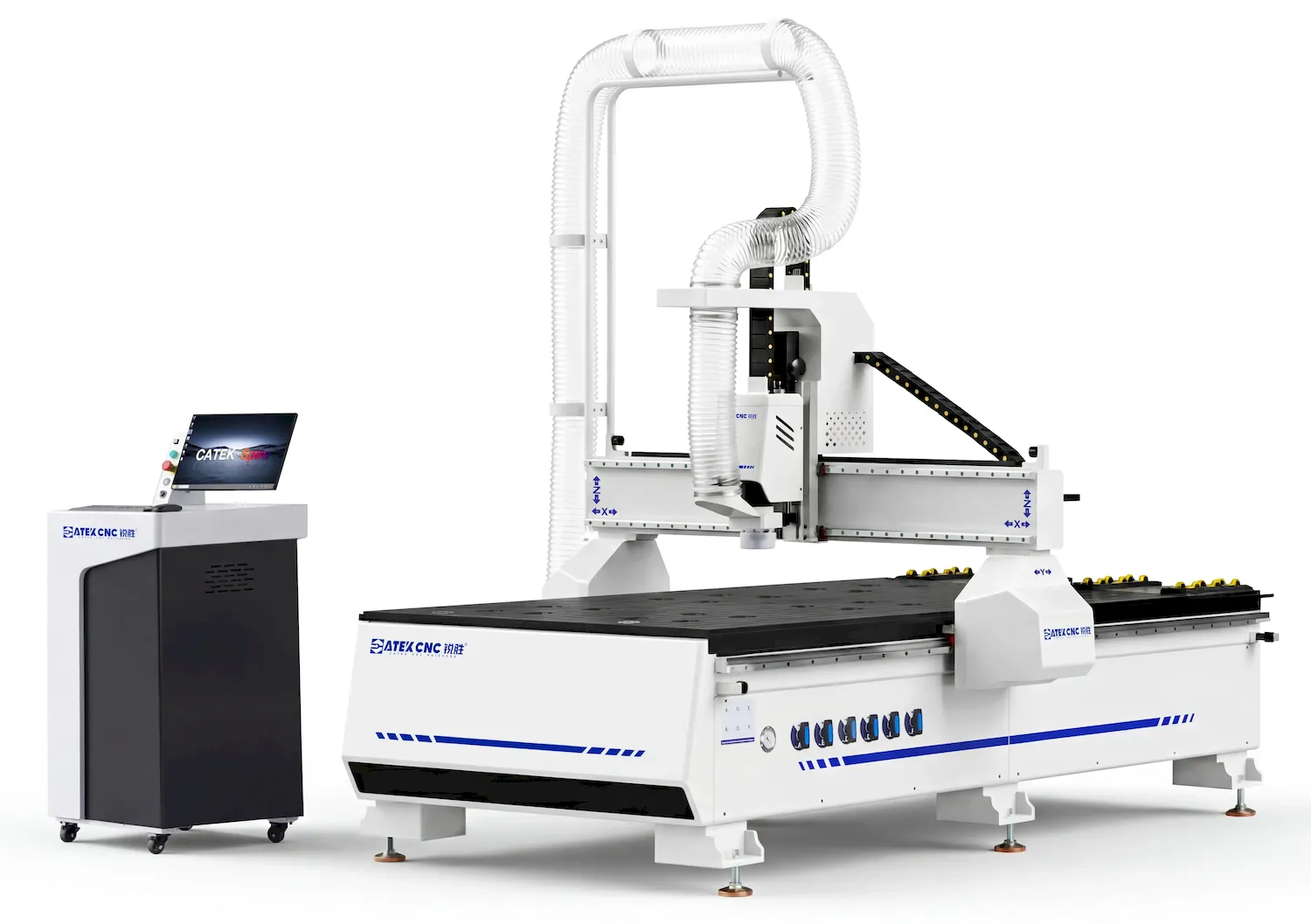
The Spire series is the high-end custom series of
CATEKCNC, featuring a completely redesigned exterior and mechanical
structure. It incorporates top-tier components from
first-tier suppliers and includes exclusive one-on-one
customer service.
Looks like you have not added anything to you cart. Goahead & explore top
categories.
{{goods.model}}
${{moneyFormat(goods.price * goods.num)}}
Total:
${{moneyFormat(total)}}
· Function Description ·
Spire 1325 4-axis CNC router features a tilting spindle head and rotary fourth axis for versatile machining. With a 4×8 ft vacuum/T-slot hybrid table, it supports multi-angle cutting, cylindrical machining, and complex 3D processing, expanding beyond standard 3-axis CNC capabilities.
Tags:Spire Series,Four-Axis,Rotary 4th Axis,Swing Head
Share:
Description
Parameters
Video
Reviews
CATEK · Spire
Expanding Complex Machining Capabilities with Combined Flat and 3D Processing, Integrating
4-Axis Tilting and Rotary Machining in One Versatile Machine.
The CK-1325-WSP-ST-4RS is a
high-end Spire series CNC router integrating a 4×8 ft vacuum and T-slot hybrid table, ±90°
4-axis tilting machining, and 360° rotary processing. Compared with standard 3-axis CNC
routers, it features a high-performance 4th-axis tilting head that allows the spindle to
rotate ±90° along the X-axis. According to the machining program, it can switch between
vertical, side, and angled cutting directions to complete complex processes such as door
lock holes, side hinge slots, angled drilling, chamfering, side milling, and inclined
contour cutting. It is also suitable for multi-angle workpieces including chair backs, stair
handrail corners, sculptures, and wooden molds.
With a 1300×2500mm flat machining area and an extended 350mm
Z-axis height, the machine handles large panels for cabinets, wardrobes, doors, and
furniture, while also supporting thicker solid wood and 3D workpieces. The detachable 4th
rotary axis provides up to 2000mm machining length and 300mm maximum diameter, enabling 360°
rotary positioning for cylindrical and rotary parts such as columns, table legs, wooden
ornaments, Queen Anne legs, and guitar necks. It supports 3D carving, slotting, drilling,
and contour milling, combining flat, angled, multi-sided, and rotary machining capabilities
in one machine.
From panel processing to complex 3D workpieces, the
CK-1325-WSP-ST-4RS reduces repeated flipping, repositioning, and multiple setups required by
traditional machining methods. It allows doors, cabinets, furniture components, sculptures,
molds, and custom-shaped products to be processed on a single platform. For batch
production, it enables efficient positioning, automatic tool setting, and continuous
machining; for customized products, users can quickly switch between flat, angled, side, and
rotary machining modes to reduce process changes and improve flexibility.
As part of the Spire series, the CK-1325-WSP-ST-4RS is backed by a
5-year warranty, 24/7 technical support, lifetime maintenance, and free software upgrades.
With dedicated after-sales service and complete technical documentation, Spire provides
continuous support from installation and commissioning to long-term production.
Core Advantages of Spire 1325
4-Axis CNC Router: Four Dimensions to Reshape the Standards of
High-Efficiency Production
01.
4×8 ft Hybrid Worktable, For
Both Flat and 3D Workpieces.
The Spire 1325
4-Axis CNC Router Equipped with a 6-zone, 24-port vacuum table
combined with an aluminum T-slot worktable, the machine provides a 1300×2500mm
machining area and 350mm Z-axis height. It handles large panels for wardrobes,
cabinets, and doors while also supporting solid wood, chair backs, and irregular
3D parts. The vacuum table enables fast panel holding, while the T-slot design
provides flexible clamping for heavy and irregular workpieces, allowing one
machine to perform cutting, engraving, slotting, drilling, and 3D machining.
02.
±90° 4-Axis Tilting, For
Multi-Angle Composite Machining.
The high-precision 4th-axis tilting head allows the
spindle to rotate ±90° along the X-axis, automatically adjusting angles
according to machining programs. It enables smooth transitions between vertical,
side, and angled cutting directions. Processes such as door lock holes, side
hinge slots, angled drilling, chamfering, and side milling can be completed
without repeated flipping. Complex parts including sculptures, wooden molds,
stair handrail corners, and chair backs can also be machined from multiple
angles in a single setup, reducing manual repositioning and improving
efficiency.
03.
Detachable 4th Rotary
Axis, Expanding Cylindrical 3D Machining Capabilities.
The desktop-style detachable rotary axis provides
up to 2000mm machining length and 300mm maximum diameter, supporting 360° rotary
positioning. It can be quickly installed or removed according to production
needs. Combined with the spindle, it enables 3D carving, slotting, drilling, and
contour milling on cylindrical and rotary parts such as columns, wooden
ornaments, table legs, Queen Anne legs, and guitar necks. Program-controlled
rotary machining eliminates repeated manual turning, expanding the
CK-1325-WSP-ST-4RS from traditional flat engraving to advanced cylindrical and 3D
processing.
04.
Advanced Safety
Protection, With 5-Year Warranty Support.
Spire features
multiple safety systems, including electronic limits, mechanical collision
protection, safety interlocks, and overload protection, providing comprehensive
protection for operation, pneumatic systems, and electrical components. Each
machine includes a dedicated nameplate and serial number, with a 5-year
warranty, 24/7 technical support, lifetime maintenance, and free software
upgrades. Complete manuals, quick guides, and a dedicated USB data package are
also included, making installation, operation, maintenance, and troubleshooting
easier while ensuring long-term reliable performance.
Choosing the Spire 1325
4-Axis CNC Router means
choosing
Higher Production Flexibility
Capable of processing flat panels, thick workpieces,
angled structures, and cylindrical rotary parts, one machine covers multiple
machining applications and reduces production changes between different
equipment.
Higher Machining Consistency
High-precision transmission systems, automatic tool
setting, quick positioning, and multi-axis coordination work together to reduce
manual alignment and repeated clamping errors, improving dimensional consistency
in batch production.
Greater Application Versatility
From cabinets, wardrobes, and wooden doors to sculptures,
columns, table legs, and other 3D components, diverse machining capabilities
allow the machine to handle customized and multi-product production with ease.
Comprehensive Long-Term Support
With a 5-year warranty, 24/7 technical support, lifetime
maintenance, free software upgrades, complete documentation, and included tools,
Spire provides reliable support from delivery through long-term production.
Heavy-Duty Machine Frame, Custom Elevated Gantry
Heavy-Duty Bed Base Dedicated to Spire
The Spire 1325
4-Axis CNC Router Built with a reinforced carbon
steel square tube welded structure, the machine bed is
specially designed for the large working area and high-load
machining requirements of the Spire 1325 CNC router. The
full-welded construction strengthens critical joints and
improves overall rigidity. The carbon steel structure
provides excellent stiffness and vibration resistance,
effectively absorbing machining vibrations and impacts.
Combined with Spire’s optimized structural design and
AI-based simulation analysis, the bed structure is
engineered for improved load distribution and dynamic
stability during high-speed cutting and continuous
operation.
Key mounting areas for linear guides and racks feature
reinforced steel strips to improve rigidity and durability.
The entire bed surface is covered with thick steel plates
for enhanced load-bearing capacity. After welding, the bed
undergoes vibration stress relief and annealing treatments
to reduce internal stress and minimize long-term
deformation. A 5-axis gantry milling process is then used to
precisely machine critical mounting surfaces, ensuring
accurate installation of transmission components and stable
machining performance.
Designed for heavy-duty processing of large panels, solid
wood, and composite materials, the machine bed features a
high-strength frame structure for improved load capacity and
durability. Even during extended high-intensity operation,
it maintains reliable mechanical performance. The exterior
is finished with an overall powder coating process, creating
a dense protective layer with excellent rust resistance,
scratch resistance, and wear resistance, helping the machine
maintain long-term durability in demanding industrial
environments.
Heavy-Duty Reinforced Gantry Beam and
Columns
Designed for the 350mm extended Z-axis travel, the Spire
1325 features a heavy-duty reinforced horizontal beam and
high-strength vertical column structure to meet large-size,
deep machining, and high-load processing requirements. The
vertical columns on both sides are welded from thick steel
plates and high-strength square tubes, with additional
reinforcement added to critical load-bearing areas. Compared
with standard column structures, this design provides higher
bending resistance and overall rigidity, effectively
reducing vibration and deformation during high-speed
machining, ensuring stable spindle operation even at
elevated working positions.
The horizontal beam adopts an integrated reinforced square
tube structure, with optimized cross-section dimensions to
improve load capacity and torsional resistance. Reinforced
steel strips are added to the mounting areas of linear
guides and racks, enhancing installation strength and
stability while preventing accuracy changes during long-term
heavy-duty operation. The connection between the beam and
columns is structurally reinforced, forming a more stable
integrated gantry system capable of handling heavy cutting,
high-speed movement, and continuous machining.
To ensure gantry installation accuracy, the beam, column
contact surfaces, and guide/rack mounting areas are
precision machined in one process using a large-scale
milling machine. This ensures higher consistency and
flatness of all critical reference surfaces. Compared with
conventional welded structures with simple post-processing,
this process reduces assembly errors, improves motion
smoothness, and enables Spire to maintain long-term
machining accuracy and mechanical stability under demanding
production conditions.
Designed for the 350mm extended Z-axis travel and 4th-axis
tilting machining requirements, the Spire 1325 features a
46mm ultra-thick one-piece aluminum alloy Z-axis plate.
Compared with conventional CNC router structures, it
provides higher rigidity and improved support for
long-stroke and heavy-load machining. Manufactured from
high-strength aluminum alloy through integrated precision
milling, the plate eliminates welded or assembled joints,
reducing structural errors while maintaining both strength
and lightweight performance.
The plate is precisely machined and structurally optimized
to achieve high rigidity while reducing the moving mass of
the Z-axis system. This lowers servo motor load and improves
lifting response and motion stability. Combined with six
Taiwan HIWIN high-precision sliders, it enhances guiding
accuracy and load capacity, maintaining excellent dynamic
stability and machining precision even when equipped with
heavy components such as automatic tool changers and
4th-axis tilting heads.
For improved long-term durability, the aluminum alloy plate
undergoes sandblasting and hard anodizing treatments,
creating a high-hardness protective surface with excellent
wear and corrosion resistance. This helps withstand dust,
oil, and continuous friction in industrial environments. The
combination of optimized structure and high-strength
materials achieves an ideal balance of lightweight design,
rigidity, and durability, providing reliable motion support
for complex surface, side, and multi-axis machining.
Heavy-Duty Adjustable Support Feet
The machine bed is equipped with six heavy-duty adjustable
support feet made from high-strength carbon steel, specially
reinforced for the machine’s weight and high-load machining
requirements. The base plates feature chrome plating, while
the screws are zinc-coated to improve corrosion resistance.
Even in humid and dusty industrial environments, the support
feet maintain long-term durability. The high-precision
threaded screw design provides smooth adjustment, even load
distribution, and strong locking force to securely maintain
the bed height.
The support bases adopt a fully solid reinforced structure,
offering higher hardness and load capacity compared with
standard thin support feet. They can withstand the
continuous loads generated by the heavy machine bed and
intensive machining operations without deformation. The
large solid bases increase contact area with the floor,
distributing machine weight evenly across multiple support
points. Combined with six-point support, the bed maintains
excellent leveling and structural stability under various
working conditions.
Each support foot is equipped with a ring-shaped
high-strength PVC rubber vibration pad, providing increased
friction while reducing minor vibrations and impacts during
operation. The pads offer anti-slip, shock absorption, and
cushioning performance. The ring design ensures more even
force distribution and stable floor contact, helping Spire
maintain reliable support, accurate leveling, and long-term
stability during continuous heavy-duty machining.
Click the icon labels to view different
machine
parts
The X, Y, and Z axes are equipped with Taiwan HIWIN 25mm
ball-type linear guides and blocks featuring a
four-direction equal-load design. This structure provides
balanced load distribution under radial, reverse, and
lateral forces. The guides also feature automatic
self-alignment capability, compensating for minor
installation errors and maintaining optimal contact between
the guide and slider, reducing resistance and improving the
accuracy and smoothness of XYZ-axis movement.
The guide rails use a 45° ball contact angle design,
combining high load capacity with excellent radial rigidity.
Radial rigidity reaches up to 1599 N/μm, with a maximum
static load capacity of 420 kN. The high-strength ball
circulation system and precision guide structure effectively
withstand impact and cutting forces during high-speed
movement and heavy-duty machining, maintaining stable
performance during long-term continuous operation.
Manufactured with high-hardness materials and precision
processing technology, the guides provide smooth movement
with low resistance and reduced vibration during high-speed
operation. The optimized ball circulation design improves
motion response and positioning accuracy, helping Spire
achieve smoother operation, higher precision, and reduced
wear over long-term use.
Taiwan YYC Ground Helical Gear Rack
The Y-axis adopts Taiwan YYC high-precision ground helical
rack, manufactured from S50C medium carbon steel. After
high-frequency hardening treatment, the tooth surface
hardness reaches HRC50–55, providing excellent rigidity,
strength, and wear resistance. The rack features a
right-hand helical angle design of 19°31′42″. Compared with
conventional straight racks, the helical structure increases
the tooth contact area, ensuring smoother and more
continuous engagement between the gear and rack. It delivers
higher torque transmission capability while effectively
reducing meshing impact and operating noise.
After heat treatment, the rack undergoes multiple precision
processes including tooth surface grinding and four-side
grinding, with accuracy controlled according to German DIN
standards, reaching DIN6 grade. The total pitch deviation
per meter is ≤0.034mm, and the tooth surface roughness can
reach Ra0.8, creating a smoother and more precise meshing
surface. High-precision pitch control effectively reduces
transmission errors and speed fluctuations, allowing the XY
axes to maintain stable and consistent movement performance
during high-speed operation and frequent reciprocating
motion.
Under the same module conditions, the helical tooth
structure provides higher load capacity, with a maximum feed
force of up to 10kN, meeting the requirements of continuous
high-torque transmission. The hardened tooth surface offers
excellent resistance against long-term wear, while the
precision grinding process further reduces friction and
operating resistance. Combining high-strength S50C material
with precision ground tooth surfaces, the YYC rack system
delivers powerful, smooth, and reliable XY-axis transmission
performance, maintaining high accuracy and stability even
during long-term high-speed operation.
Taiwan TBI High-Precision Ground Ball
Screw
The Z-axis adopts Taiwan TBI precision ground ball screws
with an internal circulation ball structure, providing a
compact design while maintaining excellent transmission
performance. The circulating balls reduce friction and
transmission resistance, requiring only one-third of the
driving torque compared with traditional sliding screws.
This allows smoother and faster Z-axis movement while
reducing power loss. The internal circulation design also
ensures stable operation for frequent Z-axis movement and
long-term continuous machining.
Using rolling friction transmission, the ball screw enables
precise micro-feed control with positioning increments below
0.1μm while effectively reducing backlash for higher Z-axis
positioning accuracy. The precision grinding process
improves thread accuracy and surface quality, ensuring
smoother and more consistent contact between the balls and
screw raceway. The high-rigidity transmission structure
reduces motion fluctuation, providing faster response and
smoother Z-axis movement.
The screw surface is precisely ground to achieve higher
hardness, better wear resistance, and a smoother finish,
effectively reducing wear during long-term operation.
Compared with standard ball screws, ground ball screws
provide superior accuracy retention, transmission
smoothness, and durability, minimizing precision degradation
caused by frequent reciprocating motion. Combined with the
high-rigidity Z-axis structure, it ensures stable and
precise transmission performance throughout extended
machining operations.
Stainless Steel Double Diaphragm Coupling
The Z-axis uses a double diaphragm coupling to connect the
servo motor and reducer, achieving direct power transmission
through a high-precision shaft and hub connection with zero
clearance. Made from 304 stainless steel, the coupling
features high structural strength, excellent corrosion
resistance, and strong torque transmission capability. The
double diaphragm design maintains stable transmission in
both forward and reverse rotation, effectively reducing
transmission errors caused by backlash in traditional
flexible couplings and delivering motor power more directly
to the Z-axis drive system.
The coupling adopts a zero-backlash rotational design. The
diaphragms absorb minor installation misalignment through
elastic deformation while maintaining high torsional
rigidity, eliminating return clearance commonly found in
traditional connection structures. The double diaphragm
structure provides both high transmission accuracy and
flexible compensation, maintaining good concentricity
between the motor shaft and reducer shaft while reducing
vibration, impact, and runout during operation. This allows
faster and smoother Z-axis reversing and positioning.
The 304 stainless steel diaphragm provides excellent
strength and durability, maintaining structural stability
under high-frequency reciprocating motion and high-torque
transmission conditions. The combination of high-rigidity,
zero-backlash transmission and precision connection
effectively reduces mechanical transmission errors,
improving Z-axis response and positioning accuracy. Even
during long-term high-frequency lifting and frequent
direction changes, the system maintains stable transmission
performance and reliable operation.
Japan SHIMPO High-Precision Planetary
Gear Reducers
The Y-axis adopts a Japan SHIMPO high-precision planetary
gear reducer, optimized for high-speed and high-accuracy
transmission applications. With backlash below 3 arcmin
(0.05°), it effectively reduces return clearance and
positioning errors during transmission, ensuring more
precise power transfer from the motor to the motion system.
The helical gear structure provides smoother tooth
engagement, reducing impact during operation while
maintaining stable power output during high-speed
reciprocating movement.
The reducer features an integrated ball bearing structure,
with tapered roller bearings designed to withstand higher
radial and axial loads while providing high rigidity and
strong torque output. Combined with precision gears and
low-backlash design, it reduces energy loss and mechanical
clearance during power transmission, improving XY-axis
response speed and positioning performance. The sealed
bearing structure also helps prevent dust and contaminants
from entering the internal components, ensuring reliable
operation in demanding machining environments.
The internal mechanism uses high-viscosity, non-separating
specialized grease to maintain long-lasting lubrication and
reduce grease loss or leakage during operation. With
operating noise as low as 60dB, the reducer delivers
smoother and quieter performance. Its long-life
maintenance-free design requires no grease replacement
within a service life of up to 20,000 hours, reducing
maintenance frequency while ensuring the XY-axis maintains
precise and reliable power transmission over extended
operation.
Both ends of the Y-axis travel are equipped with
aerospace-grade aluminum alloy L-shaped limit collision
blocks, manufactured from high-strength aluminum alloy for
an ideal balance of lightweight design and structural
strength. The surface is sandblasted to improve texture,
wear resistance, and corrosion resistance, allowing reliable
performance in demanding machining environments with dust
and oil exposure. The end of each collision block is
additionally equipped with a hard rubber buffer pad to
absorb impact energy during limit contact and reduce
mechanical shock.
The Y-axis is also equipped with a photoelectric soft limit
system, forming a dual protection mechanism together with
the mechanical collision structure. During operation, when
the XY axes approach the preset travel limits, the
photoelectric sensors detect the position in advance and
send signals to the control system, allowing the machine to
stop movement and trigger an alarm. Compared with
mechanical-only protection, the photoelectric soft limit
provides earlier response and more precise travel control.
Beyond the soft limit system, the L-shaped aluminum alloy
collision block serves as the final mechanical protection
barrier, physically preventing excessive travel caused by
abnormal operation, excessive speed, or operator error. The
soft limit provides early detection and warning, while the
mechanical limit provides end-position blocking and
cushioning. Together, they enhance XY-axis travel safety and
reduce potential impact damage to the guide rails, racks,
and motion system.
Click the icon labels to view different
machine
parts
The machine is equipped with an HQD 9KW automatic tool
change air-cooled spindle featuring an ISO30 tool holder and
ER32 collet system. With a maximum speed of 24,000rpm, it
combines high-speed performance with powerful cutting
capability, meeting the machining requirements of wood
panels, solid wood, composite materials, and other
applications. The pneumatic clamping system ensures secure
tool holding, while the ER32 collet supports various tool
sizes with shank diameters up to 20mm, allowing flexible
tool selection for different machining processes.
Unlike traditional spindles that require manual loosening
and tightening of nuts for tool changes, this automatic tool
change spindle provides a faster and more convenient
operation. Different tools can be pre-installed and locked
into ISO30 holders in advance. When a tool change is
required, the operator only needs to press the button on the
side of the spindle to release the tool holder and install
the prepared tool, significantly reducing manual adjustment
time and improving machining efficiency for processes
requiring frequent tool changes.
With 24,000rpm high-speed operation and 9KW power output,
the spindle easily handles cutting, engraving, slotting,
drilling, and milling operations. It is widely suitable for
cabinet, furniture, wooden door, whole-house customization,
and craft product processing. The air-cooled design
eliminates the need for water pumps, tanks, and coolant,
reducing maintenance requirements and avoiding potential
water leakage issues, making daily operation simpler and
more reliable.
4-Axis Swing Head
The spindle is equipped with a high-precision fourth-axis
oscillating structure, allowing ±90° tilting rotation along
the X-axis. The machining direction can be flexibly switched
between vertical, side, and angled positions, greatly
expanding Spire’s multi-dimensional machining capability.
The oscillating mechanism is driven by a CATEKCNC
self-developed 750W servo motor combined with a
high-precision RV reducer, delivering high torque, high
rigidity, and accurate positioning. The spindle angle can be
precisely controlled according to the machining program,
allowing the tool to approach the workpiece from different
directions for more flexible multi-angle processing.
The fourth-axis oscillating head enables various complex
machining operations, including angled cutting, inclined
slotting, side drilling, side milling, chamfering, angled
hole machining, and irregular contour cutting. For complex
applications such as wooden door lock holes, hinge slots,
angled holes, staircase handrail corners, molds, and wooden
models, the spindle angle can be adjusted according to
different processes, allowing continuous machining across
front, side, and inclined surfaces. Operations such as
irregular chair backrest cutting and drilling, wooden door
shaping, and side lock hole processing can all be completed
on a single machine, significantly expanding the overall
application range.
Compared with traditional methods that require repeated
flipping, repositioning, clamping, and calibration, the
fourth-axis oscillating head enables continuous machining of
front, side, and angled surfaces after a single workpiece
setup. This reduces manual handling, auxiliary operation
time, and positioning errors caused by repeated clamping. By
minimizing workpiece repositioning and improving
multi-surface processing consistency, it provides a more
efficient and accurate solution for complex
three-dimensional machining applications.
Detachable High-Precision Fourth Rotary
Axis
The machine is equipped with a detachable high-precision
fourth rotary axis, specially designed for long,
large-diameter cylindrical, shaft, and rotary workpieces. It
provides an effective machining length of up to 2000mm and a
maximum machining diameter of 300mm, meeting the
requirements for various long cylindrical materials and
complex rotary components. Supporting 360° continuous
rotation positioning, the rotary axis enables full-angle
workpiece rotation during machining, greatly expanding the
machine’s 3D processing capability. It is suitable for
applications such as Roman columns, table legs, chair legs,
and wooden sculptures, overcoming the limitations of
traditional three-axis CNC routers in cylindrical and rotary
workpiece machining.
The fourth rotary axis adopts a detachable structure and is
fixed directly onto the worktable with clamping plates,
allowing quick installation and removal. When processing
cylindrical workpieces, the rotary axis can be positioned
and secured on the worktable for immediate operation. After
machining, it can be easily removed without occupying the
main working area, allowing the machine to switch flexibly
between flat-panel processing and rotary machining. Driven
by a CATEKCNC self-developed 750W servo motor combined with
a worm gear reducer, the rotary axis provides smooth
rotation and accurate positioning performance.
Combined with spindle and rotary-axis linkage control, the
system enables various complex processes including
cylindrical engraving, slotting, drilling, and contour
milling. It can process three-dimensional curved workpieces
such as Queen Anne legs, guitar necks, and wooden decorative
sculptures. During operation, the rotary axis automatically
rotates to the required angles according to the program,
enabling continuous multi-angle machining around the
workpiece without manual flipping. This reduces operator
intervention, minimizes repositioning errors, and expands
the machine from conventional flat engraving to a wider
range of advanced 3D machining applications.
Click the icon labels to view different
machine
parts
CATEKCNC's Proprietary Servo System Ensures Ultra-Stable Operation.
CATEK CNC Self-Developed 750W Servo Motors
The XYZAB five-axis system is equipped with six sets of CATEKCNC
self-developed 750W high-performance servo motors. The Y-axis adopts
dual-side independent servo drive, providing synchronized power
output from both sides to ensure smoother gantry movement and reduce
offset and uneven torque caused by single-side drive. The Z-axis
uses servo motors with brake function, which can effectively hold
the position when the machine is powered off or stopped, reducing
the risk of spindle assembly movement caused by its own weight. With
a maximum speed of 3000rpm, the servo motors provide fast response
and meet the requirements of high-speed positioning and frequent
reciprocating motion.
The servo drive system delivers high-response and high-precision
motion control, with response time as fast as 10ms. It quickly
reacts to control commands, enabling more accurate acceleration,
deceleration, start-stop, and direction changes of each axis. The
high dynamic response reduces motion lag, allowing smoother
performance during complex trajectory machining and multi-axis
linkage operations. Combined with stable 750W power output, the
system achieves precise speed and position control while maintaining
both high-speed operation and fine machining capability.
The servo drives feature comprehensive intelligent protection
functions, including over-speed, over-voltage, overload, and
over-current protection. The system continuously monitors operating
conditions and responds quickly to abnormal situations, reducing the
impact of electrical faults on machine operation. With overload
capacity up to 3.5 times, the servo system provides stronger impact
resistance during sudden heavy loads and rapid acceleration or
deceleration. The combination of intelligent protection and
high-performance servo control ensures Spire maintains stable
operation while reducing machining interruptions caused by
unexpected conditions.
Taiwan LNC CNC Systems, Where Professional-Grade Performance Meets Intuitive Operation
Taiwan LNC MW2600A Control System
The machine is equipped with a Taiwan LNC MW2600A
high-performance CNC control system, featuring a 21.5-inch
high-definition LCD display for clear and intuitive
operation. Combined with a keyboard, mouse, and five-axis
electronic MPG handwheel, it enables program input,
parameter setting, manual movement, and machining process
control. The user-friendly interface clearly displays
function menus, operating status, machining parameters,
coordinates, and program information, simplifying operation
and improving overall efficiency.
The system supports multiple language options, allowing
users in different regions to switch according to their
operating preferences. With strong program compatibility, it
supports various G-code file formats including TAP, NC, and
TXT, and is compatible with machining programs generated by
mainstream CAD/CAM software and nesting software. Processing
files can be directly imported through a USB drive, making
program transfer faster and more convenient.
The system features comprehensive machine monitoring and
fault alarm functions, displaying axis positions, machining
status, and operating information in real time. When an
abnormal condition occurs, it provides corresponding alarm
codes and fault details, helping operators quickly identify
issues and reduce troubleshooting time. With a clear
operation logic and intuitive interface design, the MW2600A
allows even users with limited CNC experience to quickly
learn basic operations and daily machining procedures.
2.4GHz Wireless Keyboard & Mouse
The machine is equipped with a 2.4GHz wireless keyboard and
mouse set featuring a full-size key layout, comfortable key
travel, and smooth operation for daily use. With a service
life of over 3 million keystrokes, it is suitable for
long-term and frequent machine operation. The keyboard
adopts a sealed housing design, providing a more durable
structure and improved dust resistance, helping prevent wood
chips and dust from entering the internal components in
demanding machining environments.
The keyboard and mouse communicate through a 2.4GHz wireless
receiver, eliminating complex wiring and keeping the control
area clean and organized. The wireless connection provides
fast response, low latency, and strong anti-interference
capability, maintaining stable communication even in
environments with multiple electrical devices. With an
effective transmission distance of up to 10 meters,
operators can conveniently control the machine and adjust
parameters according to actual machining needs.
The wireless keyboard and mouse feature long battery life of
up to 180 days, reducing interruptions caused by frequent
charging or battery replacement. The aluminum alloy housing
provides excellent strength, durability, and industrial
environment adaptability. Combined with wireless
convenience, the system offers more flexible operation while
maintaining a clean and efficient workspace.
5-Axis Wireless Pulse Electronic
Handwheel
Equipped with a five-axis wireless pulse electronic
handwheel, using 2.4GHz wireless communication technology
for fast and stable signal transmission. The maximum
wireless transmission distance reaches 80 meters, allowing
operators to control the machine without staying beside the
control cabinet. The handwheel supports XYZAB five-axis
selection and feed rate adjustment, enabling quick switching
between different axes and movement speeds for precise and
flexible manual control. Built-in explosion-proof lithium
battery provides up to 30 days of continuous operation on a
single charge, reducing interruptions caused by frequent
charging.
The back of the handwheel features a strong magnetic
mounting design, allowing it to be directly attached to
metal surfaces such as the machine frame or control cabinet
without additional brackets. This makes storage and
operation more convenient in the machining area. The
wireless handwheel enables fine adjustments during tool
setting, rapid axis movement, and coordinate positioning
without repeatedly returning to the control system. For
complex workpieces or applications requiring frequent tool
position adjustments, it significantly simplifies operation
steps and improves setup efficiency.
The five-axis wireless handwheel can also work with the
control system’s handwheel simulation function to verify
machining programs before actual production. Operators can
manually control axis movement through the handwheel,
preview tool paths and program actions, and identify
potential path errors, collision risks, or abnormal
movements before machining begins. Combining wireless
control, precise manual positioning, and program
verification, it makes Spire machine setup, tool
calibration, and machining preparation more intuitive and
efficient.
Click the icon labels to view different
machine
parts
Premium Electrical Hardware, Building Perfection Into
Your CNC Router
Hpmont
High-Performance Vector Inverter
Control
cabinet interlock protection switch
High-Quality
Power Switches
Schneider
Electrical Components
Air
Source Connection Sliding Valve
High-Reliability
Aviation Plugs
Fully
Enclosed High-Strength Cable Carrier
High-Quality
Terminal Blocks
Hpmont 11KW High-Performance
Vector Inverter
Equipped with an HPMONT 11KW high-performance vector inverter,
specially designed to provide stable and efficient power control
for the 9KW HQD automatic tool change spindle. Adopting advanced
vector control technology, the inverter enables stepless spindle
speed adjustment according to different materials and machining
requirements, ensuring precise speed control. Whether performing
high-speed finishing or heavy-duty cutting, it can flexibly
match spindle output with actual processing demands, fully
utilizing the power capability of the 9KW spindle while
improving response speed and operational stability.
The inverter features comprehensive protection functions,
including overcurrent, overvoltage, overload detection and alarm
systems. It can respond quickly to abnormal spindle conditions,
reducing the impact of abnormal current and excessive loads on
the spindle and electrical system. During frequent spindle
start/stop cycles, acceleration and deceleration operations, the
inverter continuously monitors running conditions, ensuring
stable power output while reducing the risk of unexpected
downtime.
Equipped with an LCD display, the inverter provides clear
monitoring of spindle frequency, operating status, and fault
codes. Operators can quickly check machine conditions without
complicated procedures. When an abnormal situation occurs, the
system displays corresponding alarm information, helping users
identify and troubleshoot issues efficiently. Clear status
monitoring combined with stable vector control makes spindle
speed adjustment, operation management, and daily maintenance
more convenient.
Control Cabinet Interlock and
Short-Circuit Protection Switch
The control cabinet is equipped with a Schneider
industrial-grade safety interlock switch, deeply integrated with
the machine’s electrical system. Featuring fast response and
high durability, it provides an additional safety barrier for
equipment inspection and maintenance through intelligent
electrical safety control.
The interlock switch adopts a forced power-off safety mechanism.
When the electrical cabinet door is opened, the internal circuit
is automatically disconnected, ensuring the cabinet is
completely de-energized and preventing accidental contact with
live electrical components. Once the cabinet door is fully
closed and locked, power is automatically restored, creating a
reliable safety protection system through both mechanical and
electrical control.
The safety interlock switch provides enhanced protection during
routine inspections, troubleshooting, and maintenance
operations, significantly reducing potential electrical risks in
production environments. Throughout installation, commissioning,
operation, and long-term maintenance, Spire maintains a high
level of reliability and stability while meeting industrial
safety requirements with a user-oriented design.
Schneider High-Quality Power
Switches
The Spire CNC Router utilizes
high-quality Schneider electrical switches and is equipped with
voltmeters and ammeters to display power supply and operational
status in real time. This allows operators to easily monitor
electrical conditions and quickly identify anomalies, ensuring
stable machine operation.
The control panel features a Schneider main power switch and a
dedicated emergency stop button. The layout is clear and
intuitive, facilitating rapid power control and emergency
shutdowns when necessary, thereby enhancing operational safety
and minimizing the risk of accidents.
Additionally, the control panel includes convenient dual USB
ports for importing files and a power indicator light,
streamlining the file-loading process and providing a clear,
at-a-glance view of the machine's status.
Schneider Electrical System
The control cabinet is fully equipped with Schneider Electric
components, providing unified configuration from power input and
motion control to safety protection. Core electrical components
include Schneider circuit breakers, AC contactors, relay
modules, 24V power supply, thermal overload protectors, phase
sequence protectors, surge protectors, and safety interlock
switches. The use of industrial-grade components from a single
brand ensures better compatibility between electrical elements,
while the standardized cabinet layout makes the entire
electrical control system clearer and more stable.
Circuit breakers, AC contactors, and relay modules manage power
distribution and control for different electrical circuits,
while the 24V power supply provides stable power for the control
system and low-voltage components. The thermal overload
protector monitors motor operating conditions and provides
timely protection under abnormal loads, reducing the risk of
electrical damage caused by continuous overload operation. The
phase sequence protector continuously monitors three-phase power
status to prevent faults caused by incorrect phase sequence or
phase loss, providing more comprehensive protection for the
electrical system.
The control cabinet is also equipped with a surge protector to
defend against sudden voltage spikes from the external power
grid, while the safety interlock switch enhances electrical
safety during operation and maintenance. Each protection
component performs a dedicated function, forming a multi-level
protection system covering the power, drive, and control
circuits. With a clean and standardized electrical layout, the
cabinet allows easier inspection, maintenance, and
troubleshooting, ensuring a safer, clearer, and more reliable
electrical system.
High-Performance Pneumatic
Sliding Valve:
Equipped with a pneumatic sliding valve at the rear of the
machine, manufactured from high-strength aluminum alloy for
excellent wear resistance, corrosion resistance, and pressure
resistance. The optimized valve body design combines lightweight
construction with high structural strength, reducing operating
load while ensuring long service life. Compared with
conventional valve designs, the pneumatic sliding valve provides
easier operation, more stable opening and closing control, and
improves the overall efficiency of the vacuum and pneumatic
systems.
The valve adopts a dual sealing ring structure with multiple
sealing protection, effectively reducing air leakage caused by
wear or aging during long-term operation. The sealing
performance reaches up to 99.98%, ensuring stable pressure
control during pneumatic switching operations. The
high-precision sealing structure combined with the
corrosion-resistant aluminum alloy body enables reliable
performance even in demanding environments with dust and
humidity.
Compared with standard valves, the pneumatic sliding valve
offers approximately 30% higher pressure resistance and is
capable of continuous operation under higher-pressure
conditions. With stable sealing performance and extended service
life, it provides reliable support for the machine’s pneumatic
and vacuum control systems.
High-Reliability Aviation
Plugs
The machine body connects to the control cabinet via industrial
aviation connectors. Boasting an IP65 protection rating, these
connectors ensure that the interior of the control cabinet
remains perfectly clean and dry even in harsh shop floor
environments, effectively eliminating the risk of short circuits
or signal interference caused by environmental exposure.
Engineered to withstand the continuous vibration and repetitive
impacts of CNC machining, the connectors feature a rugged
housing and a precision-engineered contact design. This
guarantees exceptional electrical conductivity and stable data
transmission under high-intensity operating conditions,
completely preventing loose pins or intermittent connectivity
issues caused by long-term structural vibration.
The convenient "quick-connect & disconnect" design significantly
accelerates installation, commissioning, and teardown
efficiency. It greatly simplifies the operator's workflow during
machine relocation, shop reconfiguration, or routine preventive
maintenance.
Fully Enclosed Cable
Protection Drag Chain
The X, Y, and Z axes are all equipped with fully enclosed cable
protection drag chains, manufactured from high-strength nylon
material with excellent tensile strength, impact resistance,
wear resistance, and corrosion resistance. The drag chains
maintain stable performance in demanding environments, including
high and low temperature conditions. The smooth surface design
without burrs or protrusions provides low operating resistance,
allowing the chains to perform frequent reciprocating movements
along the XYZ axes with smoother operation and reduced running
noise.
The fully enclosed structure provides comprehensive protection
for internal cables, effectively preventing wood chips, dust,
oil, and other contaminants from entering the drag chain system.
This reduces the risk of cable wear during long-term operation.
With heat resistance up to 300°C, the drag chains maintain
reliable structural strength and performance even under
continuous high-frequency operation and complex machining
conditions. The combination of high-strength material and
enclosed protection keeps internal wiring organized and secure.
The drag chains centrally route the machine’s power cables,
signal cables, and pneumatic lines, maintaining clear separation
between different wiring systems while reducing cable
scattering, tangling, and interference. All cables move
synchronously with the drag chains, minimizing damage caused by
repeated bending and ensuring a more organized internal wiring
layout. During future inspection, troubleshooting, or
maintenance, cables can be quickly identified and accessed,
making service work easier and reducing overall maintenance
difficulty.
Independent Electrical
Terminal Blocks
The electrical control system features dedicated terminal blocks
for the main power supply, vacuum pump, dust collector, and
other major electrical components. Separate wiring circuits help
reduce electrical interference between equipment operating
simultaneously, improving power distribution clarity and system
stability. This circuit separation also limits the impact of
individual wiring faults on other systems, enhancing overall
electrical reliability.
Each functional module has a clearly defined wiring layout with
identifiable terminals, simplifying installation, inspection,
and maintenance. Technicians can quickly locate the relevant
circuits and terminals for troubleshooting without checking the
entire electrical system. Dedicated wiring for high-power
equipment, such as the vacuum pump and dust collector, also
helps minimize mutual interference during startup, shutdown, and
operation, providing a more stable operating environment for the
spindle, servo drives, and control system.
Through separate power distribution, independent wiring, and
modular management, Spire effectively isolates major functional
systems. When an auxiliary component requires servicing,
maintenance can be carried out more efficiently with minimal
disruption to other systems. This organized electrical layout
keeps the control cabinet neat while supporting long-term
operational reliability and convenient maintenance.
Automatic Tool Setting and Portable Tool Changing
Enhance Machining Efficiency and Speed.
High-Precision Contact Automatic Tool Setter
The spindle is equipped with a high-precision contact automatic tool
setter, specially designed for rapid calibration of tools with
different lengths and specifications. It can automatically detect
the actual tool length and complete tool length compensation. The
tool setter adopts a fully sealed pure copper sensor, featuring high
sensitivity, excellent stability, and precise triggering
performance. With a maximum tool setting accuracy of 0.001mm, it
effectively reduces errors caused by manual measurement and
parameter input, ensuring consistent machining depth and cutting
height after each tool change.
The automatic tool setter is installed on the left side of the
spindle sheet metal cover, providing a clear position and convenient
access. During operation, the tool setter is placed directly beneath
the tool, and the automatic tool setting function is selected
through the control system. The Z-axis then automatically descends
to contact the setter for measurement, retracts after completion,
and writes the detected tool length data into the system for
automatic compensation. The entire process eliminates repeated
manual measurement, calculation, and parameter entry, making tool
calibration faster and more efficient.
A single tool calibration can be completed within 5 seconds, making
it especially suitable for continuous machining applications
requiring frequent tool changes. Compared with traditional manual
tool setting methods, automatic measurement reduces dimensional
deviations caused by human operation while minimizing issues such as
over-cutting, under-cutting, and improper tool contact caused by
inaccurate tool height settings. Combined with automatic length
compensation, different tools can quickly return to the correct
machining height after replacement, reducing setup time and
improving overall machining efficiency and batch production
consistency.
ISO30 Tool Holder Quick Removal Device
The right side of the machine’s vertical column is equipped with an
ISO tool holder quick removal device, manufactured from
high-strength aluminum alloy with an integrated structure that
combines durability with lightweight design. Specifically designed
for ISO tool holder installation and removal, the device features a
high-strength steel positioning slot inside, securely holding the
tool holder in place. During removal, the tool holder can simply be
placed into the corresponding slot for quick positioning, preventing
shaking or slipping during manual disassembly and making tool
changes safer and more convenient.
During operation, the ISO tool holder is placed directly into the
steel positioning slot and secured, then the ER32 dedicated wrench
can be used to easily tighten or remove the tool. No additional
fixtures or temporary holding methods are required. The positioning
slot is precisely designed according to ISO tool holder dimensions,
ensuring stable positioning while reducing the risk of surface
scratches or damage during removal. Even when frequently changing
different tools, operators can complete tool holder replacement
quickly, reducing auxiliary operation time.
The quick removal device is installed on the right side of the
vertical column, allowing easy access without occupying the
machining area. For applications requiring multiple pre-set tools
and frequent ISO tool holder changes, it significantly improves tool
preparation and replacement efficiency. The high-strength aluminum
alloy body combined with a steel positioning slot provides both
durability and accurate positioning, ensuring a more stable and
efficient ISO tool holder changing process.
Complete Auxiliary Loading and Unloading
System—Saves Labor and Time, and Boosts Efficiency.
Vacuum Worktable
Vacuum Zone Control Switches
4+2 Positioning Cylinders
Auxiliary Loading Rollers
The machine features a dual-mode workholding design combining a
6-zone 24-port vacuum clamping table and an aluminum T-slot
clamping system, allowing flexible switching according to different
machining requirements and covering a wide range of applications.
The vacuum system supports independent control of six zones, with 24
vacuum ports evenly distributed across the table surface to provide
strong and uniform holding force. During batch production, large
panels can be quickly secured without additional fixtures, reducing
setup time while avoiding surface damage. The aluminum T-slot system
provides flexible mechanical clamping for workpieces of various
shapes and sizes, making it especially suitable for small-batch
production and custom machining. It can also operate without
activating the vacuum pump, reducing power consumption.
The worktable surface is manufactured from high-hardness,
wear-resistant PVC and precision milled as a single piece, providing
excellent flatness, smoothness, waterproof performance, and
corrosion resistance. The surface is less likely to retain wood
chips and dust, making cleaning and maintenance easier. Standard
aluminum T-slot rails are integrated into the table surface with a
secure and rigid connection, maintaining high strength and
deformation resistance. Combined with clamps, bolts, and other
universal fixtures, the T-slot system can securely hold heavy solid
wood, engineered materials, foam, and other large workpieces,
ensuring stable positioning throughout the machining process.
The hybrid worktable requires no additional modification and is
designed to support different production modes with maximum
flexibility. For high-volume standardized production, the vacuum
system can be used independently for rapid panel positioning and
efficient clamping. For customized orders or irregular workpieces,
the T-slot system provides flexible mechanical fixation without
limitations on size or shape. The two methods can also work
together, with vacuum clamping securing the workpiece surface
while T-slot clamps provide additional support for enhanced
stability. This flexible combination improves machining efficiency,
expands workholding capability, and allows operators to activate
only the required vacuum zones to optimize energy consumption and
reduce long-term operating costs.
The vacuum table is equipped with six independent vacuum zone
control switches, with each switch controlling one dedicated
clamping zone. Each zone contains four vacuum ports, providing a
total of 24 vacuum clamping points across the worktable. Operators
can flexibly activate or deactivate different zones according to the
actual size, shape, and placement of the workpiece. When machining
smaller panels, only the required zones need to be activated to
avoid unnecessary vacuum loss. For standard 4×8 ft panels, all six
zones can be enabled to utilize the full clamping area of the
worktable.
Each vacuum zone operates independently, allowing the clamping
area to be adjusted according to different workpiece requirements.
Whether processing full-size panels, partial sheets, or multiple
smaller workpieces, the system can quickly match the appropriate
vacuum area. Independent zone control reduces vacuum leakage from
unused areas, concentrates vacuum output, and improves holding
efficiency. Combined with 24 evenly distributed vacuum ports, the
system provides more uniform clamping force, reducing the risk of
workpiece movement or lifting during machining and ensuring flexible
and stable fixation for various workpiece sizes.
The worktable is also equipped with a high-precision vacuum pressure
gauge, allowing operators to monitor the current vacuum level in
real time and clearly understand the actual holding condition. In
cases of air leakage, reduced suction force, or poor workpiece
sealing, abnormal pressure changes can be quickly identified for
inspection and adjustment. Each vacuum zone switch is accompanied by
a clear zone layout diagram, indicating the corresponding location
and switch number of each area. With intuitive zone identification
and simple control logic, operators can quickly select and operate
the required vacuum zones, even during initial use.
The vacuum table is equipped with a 4+2 L-shaped pneumatic
positioning cylinder system, centrally controlled by the CNC system
for automatic lifting and lowering, enabling fast and precise panel
positioning. Four positioning cylinders are installed on the far
left side along the Y-axis, while two cylinders are positioned at
the front of the worktable along the X-axis, creating clear
horizontal and vertical positioning references. During loading,
operators only need to push the panel against the raised positioning
cylinders to quickly align the workpiece, eliminating repeated
measuring, marking, and manual adjustment. This significantly
reduces setup time while maintaining consistent machining references
between different batches of panels.
The positioning cylinders are manufactured with industrial-grade
wear-resistant seals and high-strength aluminum alloy bodies,
featuring a compact structure optimized for worktable installation.
When raised, the cylinders quickly form positioning stops to align
the panel edges accurately. After positioning is completed, the
cylinders retract below the table surface, leaving the machining
area fully clear and preventing interference with tool movement.
This design supports various processes including cutting, engraving,
drilling, and slotting. With fast response and high repeat
positioning accuracy, the system improves loading efficiency for
batch panel production.
The 4+2 positioning cylinder layout is especially suitable for
double-sided panel machining. After completing machining on one
side, the workpiece can be flipped and repositioned against the same
reference points without repeated measurement or re-establishing the
origin. Compared with traditional manual positioning methods, this
system reduces errors caused by repeated alignment and clamping,
minimizing issues such as inconsistent dimensions and shifted hole
positions. It ensures smoother front-and-back side processing and
improves machining consistency and finished product quality in batch
production..
Equipped with 32 auxiliary loading rollers arranged in a 4-row ×
8-column matrix layout at the rear of the machine bed, covering the
rear sheet metal protection area and specially designed for loading
large and heavy panels. The rollers are made of high-strength nylon
with rounded surface treatment, providing smooth movement and low
resistance. During panel loading, they reduce direct friction
between the material and the table surface, minimizing the risk of
scratches and impacts. This design provides better surface
protection for materials with high finish requirements, such as
painted panels, melamine boards, and acrylic sheets.
The matrix roller layout distributes panel weight across multiple
support points, ensuring more balanced force distribution during
movement and reducing sagging, jamming, or dragging caused by heavy
panel weight. By replacing sliding friction with rolling friction,
the loading resistance is significantly reduced. Even when handling
large and heavy panels, operators can move materials more easily
with less manual effort, making the loading process faster and more
convenient.
The auxiliary loading rollers not only improve loading efficiency
but also simplify preparation for different panel sizes. Panels can
be smoothly moved into the working area along the rollers, reducing
manual handling and repeated adjustments, especially suitable for
continuous batch production. Compared with traditional manual
lifting methods, the roller-assisted loading system reduces labor
requirements and handling costs while minimizing the risk of
collision, tilting, and surface damage, making the entire process
from loading and positioning to machining more efficient and
seamless.
Top-tier Dust Removal and Vacuum System—Enabling Dust-Free Processing and Automatic
Clamping.
Equipped with a 7.5KW pulse cyclone dust collector driven by a 7.5KW
full copper motor, delivering a maximum airflow of 11,000m³/h with
powerful suction and reliable continuous operation capability. The dust
collection system adopts a multi-stage filtration structure. Dust-laden
air first enters the cyclone separation chamber, where high-speed
rotating airflow separates and collects most wood chips, waste
materials, and larger particles into the dust bin. Approximately 99% of
larger particles are separated at the first stage, while remaining fine
dust passes through the high-precision filter cartridge for secondary
filtration, further improving overall dust removal efficiency.
The filter cartridge adopts a high-precision polyester fiber filter with
filtration efficiency up to 99%, effectively capturing fine dust
generated during machining. The system is equipped with automatic pulse
cleaning, allowing users to set cleaning intervals according to actual
operating conditions. High-pressure pulse airflow quickly removes dust
accumulated on the filter surface, reducing clogging and maintaining
stable suction performance. The transparent filter design allows
operators to easily monitor the internal filtration and dust
accumulation status, making cleaning and maintenance more convenient.
The dust collector connects directly to the spindle dust hood through
the dust collection pipeline, enabling synchronized dust extraction
during machining. Wood chips and dust generated at the cutting area are
collected immediately, reducing airborne dust dispersion and improving
the working environment. The dust collector is equipped with universal
casters for flexible movement and features a 250L large-capacity dust
bin, reducing the frequency of cleaning and supporting more efficient
continuous production.
The vacuum table is equipped with a 7.5KW variable-frequency
constant-pressure vacuum pump, featuring intelligent frequency control
technology that automatically adjusts operating frequency and output
power according to actual machining loads. The system maintains a more
stable vacuum pressure, with a maximum negative pressure of -50KPa and
airflow capacity of up to 520m³/h. With strong suction performance, it
can quickly establish stable vacuum pressure for both small workpieces
and large panels, ensuring firm adhesion to the worktable and reducing
movement or lifting during machining.
The vacuum pump adopts a water-free and oil-free operating design,
requiring no water circulation or lubricating oil during operation. This
helps prevent oil contamination, reduces routine maintenance
requirements, and provides a cleaner, more convenient user experience.
Combined with 6 independent vacuum zones, the system allows operators to
activate only the required areas according to workpiece size, improving
suction efficiency while maximizing vacuum performance.
The variable-frequency constant-pressure control system dynamically
adjusts pump operation according to real-time load conditions. Compared
with conventional vacuum pumps that continuously run at full power, this
technology can reduce unnecessary energy consumption by up to 30%. When
machining small workpieces or partial areas, the system automatically
reduces output; when processing large panels, it quickly increases power
to maintain stable suction. By balancing holding performance and energy
efficiency, the vacuum system ensures reliable machining while reducing
long-term operating costs.
Variable Frequency
-50KPa
520m³/h
Automatic Lubrication for the Entire Machine—Saving
Time and Providing Peace of Mind.
1.5L Large-Capacity Automatic Lubrication System
The transmission system is equipped with a 1.5L large-capacity
automatic lubrication reservoir featuring a fully automatic
gear-driven oil pump, which provides timed and quantitative
lubrication according to actual machine operating conditions. The
lubrication duration can be adjusted from 1–90 seconds, while the
interval time can be flexibly set from 3–399 minutes. This allows
the lubrication cycle to be optimized according to different
machining intensities and usage frequencies, ensuring continuous
lubrication for key transmission components such as linear guides
and ball screws, reducing friction, wear, and running resistance
caused by insufficient lubrication.
The oil reservoir is equipped with a low oil-level alarm float,
which automatically alerts operators when the lubricant level is
insufficient, preventing dry friction caused by oil shortage. The
lubrication system also features a multi-layer filter mesh, which
effectively filters impurities from the lubricant and prevents
contaminants from entering the oil circuit and transmission
components. This ensures smooth oil delivery while improving
filtration performance and long-term system reliability.
A high-precision pressure gauge is integrated into the system to
display real-time oil pressure status, allowing operators to monitor
lubrication conditions without disassembly. Any abnormal pressure
changes can help identify issues such as oil blockage or
insufficient supply at an early stage. Combined with a
large-capacity reservoir, automatic timed lubrication, and oil
level/pressure monitoring, the system reduces manual maintenance
frequency, simplifies daily servicing, and extends the service life
of critical transmission components.
Oil Drip Tray for Z-Axis
A dedicated oil collection tray is installed beneath each Z-axis,
with one tray for each of the two independent Z-axis drive systems.
The trays collect excess lubricant from the linear guides, ball
screws, and other moving components, preventing oil from dripping
onto the worktable or workpiece surface. This helps minimize oil
contamination, rework, and material waste, especially when machining
products that require clean, high-quality surfaces.
The trays collect excess lubricant in one place, keeping the machine
and work area cleaner while reducing lubricant waste. They also
allow operators to monitor oil accumulation more easily during
routine inspections and perform timely cleaning and maintenance,
helping maintain organized lubrication management and reduce
long-term maintenance costs.
Both trays feature a simple mounting structure secured by just two
screws on each side, allowing quick removal and reinstallation.
Operators can easily remove the trays for cleaning without
complicated tools, making routine maintenance faster and more
convenient while improving the machine’s overall practicality.
Behind Your Spire, Backed by Our Total Dedication
Spire Series Exclusive Nameplate &
Comprehensive Service Support
Every Spire CNC Router is equipped with
an exclusive nameplate and unique serial number on the rear side, providing
a dedicated identity code and after-sales service record for every unit.
Through the unique serial number, users can access CatekCNC official
warranty services, technical consultation, and after-sales support. Each
machine comes with a 5-year extended free warranty, far exceeding the common
1-year industry warranty period. The serial number system creates a complete
equipment service record, ensuring standardized, transparent, and reliable
support throughout the entire machine lifecycle.
The Spire Series also provides a
dedicated one-on-one professional after-sales service team with 7×24-hour
online technical support. Through remote guidance and video assistance,
technicians can help operators quickly identify equipment issues,
troubleshoot problems, and provide effective solutions, reducing production
downtime caused by unexpected failures. In addition to the standard warranty
service, users can enjoy lifetime free maintenance, free software upgrades,
and free programming and drawing assistance, providing continuous technical
support for different machining requirements.
The rear side of the machine is also equipped with operation guidelines and
maintenance instructions, clearly outlining daily operating requirements,
lubrication schedules, and key inspection points. Operators can easily
follow the instructions for routine maintenance without searching through
additional documents. Standardized maintenance and regular inspections help
identify potential issues in advance, reduce equipment failures caused by
improper operation or insufficient maintenance, and ensure long-term stable
performance while extending the service life of the machine.
Spire Series Complete Documentation Kit
Each Spire series machine is delivered
with a complete set of dedicated technical documents, including the machine
certificate, warranty card, warranty terms, quick operation guide, and full
user manual. All documents are complete and systematically organized upon
delivery. The warranty card and warranty terms clearly outline the warranty
policy and service details, allowing users to access the 5-year machine
warranty service. The complete documentation system provides clear
references throughout machine delivery, installation, operation, and
long-term use.
The quick operation guide is designed for daily machine use, providing clear
instructions on machine components, electrical connection procedures, vacuum
pump and dust collector wiring diagrams, and standard startup procedures. It
also includes common fault symptoms, basic troubleshooting methods, and
routine maintenance tips. Operators can quickly locate the required
information without searching through extensive documents, making it
especially useful for initial installation, commissioning, and daily
production operations while reducing errors caused by unfamiliar operation.
The full user manual adopts a detailed combination of text and
illustrations, covering machine structure, component functions, installation
procedures, commissioning steps, and standard operating processes. It also
includes regular maintenance schedules, common fault diagnosis, and
troubleshooting methods, providing guidance from basic operation to
professional maintenance. Even operators with no prior experience using CNC
routers can follow the manual step by step to quickly learn machine
operation, maintenance procedures, and basic troubleshooting, improving
overall equipment utilization.
Everything Is Ready — Unbox, and Get Straight to Work
Spire Exclusive Double-Layer Tool Kit
Each Spire series machine is additionally equipped with a double-layer fully
equipped accessory toolbox, designed to organize commonly used tools and
components required for machine installation, operation, maintenance, and
machining. The toolbox includes a 2.4G wireless keyboard and mouse set,
complete Allen key set, ER32 spindle wrenches, spare air nozzles, spare
relays, spare limit switches, and other practical accessories. It also
includes 6 ISO tool holders and 6 aluminum alloy clamps, providing essential
support for daily tool preparation, workpiece fixation, and machine
maintenance.
The toolbox is also equipped with an 18-piece ER32 collet set covering sizes
from 3mm to 20mm, allowing flexible matching with different tool diameters
for various machining applications such as cutting, engraving, slotting,
drilling, and milling. In addition, a 35-piece professional milling cutter
set is included, featuring forming cutters, engraving tools, ball nose
cutters, and cutting tools. This allows operators to quickly select suitable
tools according to different materials and machining requirements, reducing
the need for additional tool purchases.
The toolbox also includes an Spire exclusive USB drive containing complete
electronic machine documentation, including the user manual, control system
backup files, machine test operation files, electrical diagrams, and
pneumatic diagrams. These resources can be accessed during machine
installation, commissioning, system maintenance, and troubleshooting. The
double-layer toolbox adopts a categorized storage design, keeping tools,
cutters, and technical documents organized and easy to access, providing a
complete solution from installation and setup to daily production.
Toolbox First LayerToolbox Second
LayerMachining Tool Collet
SetMachining Tool Set
Applicable Industries
Whether furniture such as wardrobes, cabinets, and doors, or 3D components like table and
chair legs, sculptures, tool handles, etc., The Spire can
handle it all with ease.
Easily explore helpful answers to the questions our users ask
most,so
you can understand the Spire better
and get support instantly.
Contact Us Now!
+86 135 8313 8886
1. What is the biggest difference between a 1325 4-Axis CNC Router with Swing Head and Rotary 4th Axis and a standard 3-axis CNC router?
The biggest difference is the addition of two machining dimensions. The swing head allows the spindle to tilt ±90° along the X-axis, enabling direct machining of side and angled features such as door lock holes, hinge slots, angled holes, chamfers, and side milling without repeated flipping. The rotary 4th axis supports continuous 360° rotation for 3D carving, grooving, and drilling on cylindrical workpieces. One machine covers flat, angled, multi-sided, and cylindrical 3D machining applications.
2. What products can be processed by the flat table, 4-axis swing head, and rotary 4th axis respectively?
Flat table machining: Suitable for flat materials and panel products such as cabinets, wooden doors, wardrobes, bookshelves, coffee tables, bedside cabinets, advertising signs, screens, plaques, door signs, and wooden crafts.
4-axis swing head machining: Designed for angled and multi-sided machining, it can process products such as side lock holes on wooden doors, curved chair backs, guitar side panels, piano keyboard covers, thermoforming mold cavities, wooden molds, carbon fiber automotive spoilers, electronic housings, side profiles of wooden sculptures, curved lettering, and irregular headboards.
Rotary 4th axis machining: Designed for cylindrical and rotary workpieces, it is suitable for staircase columns, railing posts, sofa legs, table and chair legs, baseball bats, guitar necks, instrument tuning pegs, wooden figures, sculptures, and wooden toys.
Users can select the appropriate machining function based on product shape and requirements, or switch between different functions on one machine to achieve versatile multi-purpose production.
3. When is a CNC router with a 4-axis swing head and rotary 4th axis the best choice?
A CNC router with a 4-axis swing head and rotary 4th axis is the ideal choice when your products require not only flat nesting but also side machining, angled cutting, multi-angle processing, or cylindrical 3D carving. Unlike standard 3-axis CNC routers that machine only from a fixed vertical direction, the swing head enables ±90° angle adjustment for complex operations such as wooden door lock holes, side hinge slots, angled holes, chamfers, and irregular angled surfaces. The rotary 4th axis is designed for cylindrical and rotary products, including Roman columns, stair handrails, table and chair legs, and wooden sculptures.
For businesses involved in furniture, wooden doors, solid wood customization, wood crafts, and model making that require diverse products, small-batch production, and high flexibility, a 4-axis CNC router provides a more efficient solution. It reduces repeated flipping, repositioning, and multiple setups, expands machining capabilities, improves machine utilization, and lowers the need for additional equipment investment.
4. Why does the CK-1325-WSP-ST-4RS 4-axis CNC router with an automatic tool change spindle still require manual tool replacement? What is the difference compared with a standard spindle?
The Spire1325-WSP-ST-4RS is equipped with a HQD 9KW automatic tool change spindle using the ISO30 tool holder and ER32 collet system. Compared with a standard manual tool change spindle, the biggest advantage is that multiple tools can be pre-installed on separate ISO30 tool holders in advance. When different tools are required during machining, operators only need to quickly remove the current tool holder and install the prepared one, instead of repeatedly loosening and tightening the collet, significantly reducing tool change preparation time and improving multi-process machining efficiency.
Unlike traditional spindles that require manual adjustment of each tool in the collet, the ISO30 tool holder system provides standardized tool installation and higher repeatability after tool replacement. Although this model uses manual replacement of tool holders instead of a fully automatic tool magazine system, it combines the high performance of a 9KW spindle with a more economical tool change solution. It is especially suitable for furniture, wooden doors, solid wood processing, and other production environments that require frequent tool changes while balancing efficiency and equipment cost.
5. What are the advantages of a vacuum suction + aluminum T-slot hybrid worktable?
Traditional CNC routers usually use only one type of worktable. A vacuum suction table is highly efficient for quickly fixing large flat panels, but its adaptability can be limited when processing small, irregular, or heavy workpieces. A pure T-slot table provides flexible clamping options but requires more time for fixture setup during high-volume panel production. The CK-1325-WSP-4RS adopts a hybrid worktable design that combines vacuum suction and an aluminum T-slot system, integrating the advantages of both fixing methods.
When processing standard panels such as cabinet boards, wardrobe panels, and wooden doors, the vacuum suction system enables fast positioning and improves batch production efficiency. When machining solid wood, irregular parts, sculptures, models, or thick materials, the aluminum T-slot system can be used with clamps and fixtures for stronger mechanical fixing. This hybrid worktable allows one CNC router to handle both standardized production and customized machining needs, reducing the need for multiple machines and improving overall equipment versatility and utilization.
6. What is a 4-axis CNC router? What types of 4-axis CNC routers are available?
A 4-axis CNC router is a machine that adds an additional rotary or swing motion axis based on the traditional XYZ three-axis system, providing more flexible machining capabilities. Compared with standard 3-axis CNC routers, 4-axis machines can reduce repeated workpiece flipping and repositioning, enabling side machining, angled cutting, multi-face processing, and 3D carving.
There are mainly two types of 4-axis CNC routers:
1. Rotary 4th axis CNC router:
By adding a rotary axis, the workpiece can rotate 360° for multi-angle machining. It is mainly used for cylindrical and rotary workpieces, such as Roman columns, stair handrails, table legs, chair legs, wooden sculptures, and other 3D products.
2. Swing head 4-axis CNC router:
By adjusting the spindle angle, the cutting direction can be changed to process complex features such as side grooves, angled holes, chamfers, angled surfaces, and multi-face contours.
For users who need both multi-angle machining and cylindrical 3D processing, a 4-axis CNC router equipped with both a swing head and rotary 4th axis can provide a wider range of machining applications and greater production flexibility.
Last Updated:
2026-10-12 20:32:23
Technical Parameters
Series
CATEK ·Spire
Model
CK-1325-WSP-ST-4RS
XYZ Working Travel
1300*2500*350mm
Rotary 4th Axis Capability
2000*300mm (length*diameter)
Bed
Spire-specific machining center processed reinforced bed base, independent anti-interference
control cabinet
We use cookies to personalise content and ads, to provide social media features and to analyse our
traffic. We also share information about your use of our site with our social media, advertising and
analytics partners who may combine it with other information that you’ve provided to them or that
they’ve collected from your use of their services.
You may modify your privacy preferences at any time by accessing the "Your Privacy Choices" link
located at the bottom of the page.


 Five-years free warrantyEnjoy Spire VIP service, providing free warranty and maintenance for the entire machine, bringing you a worry-free experience.
 Exclusive private customer service and after-sales team7*24 hours online service, on duty around the clock, to solve any problems for you as soon as possible.
 The matching CNC software is given for freeEnjoy lifetime free software upgrades, supporting software updates and free programming services.