MEET CATEKCNC

Most Popular 4-Axis CNC Router for 3D Carving in 2026

4-axis CNC routers adds an additional rotary axis to the traditional three-axis router, making it more powerful. This type of machine is mainly divided into two types: The first type has a machine structure similar to a lathe, equipped with an indexing rotary axis for clamping and rotating the workpiece, thereby enabling machining on multiple surfaces or revolving surfaces of the workpiece. This type of machine is mainly used to produce products such as Roman columns, stair handrails, and statues. The second type is called a swing-head CNC router, which adds an axis (A-axis) to the spindle that can rotate up to ±90 degrees in the X-Z plane, allowing the spindle to tilt at a certain angle in this plane. It is suitable for machining wave boards, irregular chair backs, and models with curved surfaces. The 4-axis CNC routers can machine multiple surfaces of a workpiece or perform machining at non-perpendicular angles, making its application range extremely wide. Users can choose the appropriate machine model based on their actual machining needs.

Showing 13–24 Of 13 Results
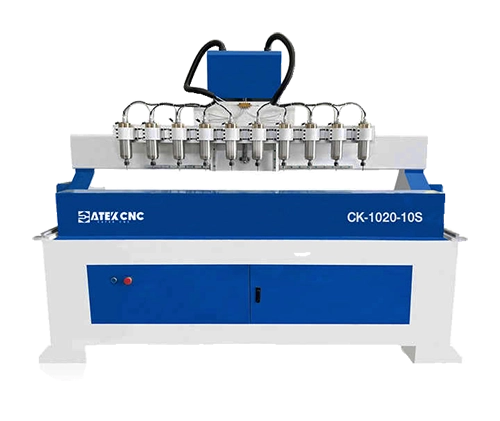
  • Multi-Head CNC Wood Router for Batch 3D Carving
    The machine features multiple workstations, each equipped with a rotating device for workpiece and machining spindle for batch processing of surfaces-of-revolution.
    $10,300.00~$13,900.00

USE CNC FOUR-AXIS ROUTER TO ACHIEVE MULTI-ANGLE PROCESSING

In the big family of CNC router, 4-axis CNC router occupy an important position. They are mainly used to process some 3D products. At the same time, they also have the processing capabilities of three-axis CNC router, which are suitable for users with a variety of product types to choose to use. Our 4-axis CNC router are divided into two types: four-axis-linkage with rotating axis and four-axis-linkage with spindle axis swing. Users can choose the appropriate style and model according to their actual use.

Next, we will introduce the structure, working principle, application and other aspects of this type of machine in detail to help you understand the details of the latest four-axis-linkage 3D CNC router in 2026.

What Is a Four-Axis CNC Router?

Generally speaking, a four-axis and four-link CNC router uses four drive motors to drive the engraving spindle or workpiece to move or rotate to complete a three-dimensional workpiece, and these axes can move simultaneously. Please note that only when the four axes can move simultaneously can a more complex workpiece be completed. It is not enough to just equip it with four motors. This also requires the CNC system to have the corresponding functions.

At present, there are two common forms of this CNC router. One is based on the ordinary XYZ three-axis machine, with an additional rotating axis (A axis) that can dynamically control the speed. The rotating axis can work in conjunction with the spindle. Its structure is very similar to that of a four-axis linkage lathe. The device that drives the workpiece to rotate can also be divided into two types: center and chuck. It is used to fix long strip workpieces with circular or square cross-sections or special-shaped workpieces that are pasted together. One end is driven by a drive motor to drive a reducer or gear to indexing rotate, and then the engraving head engraves the workpiece. This structure is suitable for processing the convoluted surface of columnar products such as table and chair legs, figures, and sculptures. Another type is improved from the common three-axis CNC router. On the basis of the up and down movement of the main axis (Z axis), a device that can perform 180-degree circular indexing rotation is added. The rotation plane of this device is on the xz-plane and is driven by a servo motor to complete the processing of the vertical surface, inclined surface or curved surface of the workpiece. From the front view, the main axis of this CNC router swings left and right with the tail as the fulcrum, so we also call it a "swing head CNC router". This type of CNC router is often used in models, molds, corrugated plates, three-dimensional reliefs with curved surfaces and other processes.

Although the mechanical structures of these two types of CNC routers differ, both can access the surface of the material from multiple angles to complete the processing work. Many complex processes that cannot be accomplished by the movement of linear axis of an ordinary 3-axis CNC router can be well-completed by them. As for how to make a specific choice, it still depends on the products that actually need to be processed.

How The 4-Axis CNC Router Works?

The working principle of the four-axis CNC router is to add a rotating axis to the 3-axis CNC router, so that the tool or workpiece can rotate around the rotating axis, ensuring that the tool can contact the processing surface at a certain angle, thereby realizing complex processing operations on three-dimensional, curved and vertical surfaces. This type of machine usually has three linear motion axes, X-axis, Y-axis and Z-axis, and a rotating axis (A-axis or C-axis). The X-axis, Y-axis and Z-axis are orthogonal, and the tool moves in the Z-axis direction, so that it can process the surface of the workpiece parallel to the X-axis and Y-axis, while the rotating axis controls the spindle or workpiece to rotate at a certain degree. This design enables the CNC router to perform complex processes such as multi-faceted processing, curved surface processing, bevel processing, and rotation processing on the workpiece.

The four-axis CNC router can make the tool fit the material surface more closely for engraving, so that it can process more complex and finer patterns and shapes than the three-axis CNC router, greatly improving the richness, processing effect and precision of the processable products. At the same time, this type of machine can also increase the engraving head multi-station batch processing, further improving production efficiency.

Application Scope

It can be used to 2.5D relief and 3D carving of various non-metallic materials, and to process various complex curve patterns, curved arcs, bevels, vertical surfaces, bent feet, etc.

The materials that can be processed are: solid wood, engineered wood, composite wood, plastic, glass, POM (polyoxymethylene), PTFE (polytetrafluoroethylene), nylon, PVC, PU (polyurethane), ABS plastic, rubber amine, phenolic plastic, acrylic, rubber amine and phenolic plastic (bakelite), carbon fiber, fiberglass, wood substitute, foam, PMI material, plaster and other non-metallic materials.

Application industries:

  • Furniture industry: European table and chair legs, corrugated boards, curved arc boards, retro furniture, wooden doors, screens, stair railings, Roman columns, sofa legs, etc.

  • Woodworking industry: portraits, sculptures, Buddha statues, decorative ornaments, vases, wooden toys, axe handles, hammer handles, etc.

  • Mold industry: yacht molds, car molds, aviation models, foam molds, plaster molds and other non-metallic material models.

  • Musical instrument industry: guitar, piano, violin, cello, zither and other musical instrument accessories.

Specifications

Four-Axis Swing Head CNC Router Four-Axis CNC Wood Sculpting Machine
Processing Size 1200mm*1200mm, 1300mm*2500mm, 1500mm*3000mm, 2000mm*3000mm, 2100mm*4000mm, etc. Processing Length 600mm, 900mm, 1200mm, 1500mm, 2500mm, 3000mm, etc.
Processing Height 200mm, 300mm, 400mm, 500mm, 600mm, 800mm, etc. Processing Diameter 100mm, 200mm, 300mm, 500mm, 800mm, etc.
Table T-slot/vacuum clamping Rotary Axis Type Center/chuck
Rotatable Angle 180 deg Rotatable Angle 360 deg
Drive Mode AC Synchronous Servo Drive Drive Mode Stepper/Servo
Processing Capabilities 2D and 2.5D cutting, drilling and engraving of curved, inclined and vertical surfaces Processing Capabilities Cutting, carving and milling of surface-of-revolution
Price $3285-22850 Price $1750-14000
Control System DSP, Mach3, Mach4, Ncstudio, OSAI, Siemens, Syntec, LNC, FANUC
Compatible Software ArtCAM, Type3, Cabinet Vision, CorelDraw, UG, Solidworks, MeshCAM, AlphaCAM, UcanCAM, MasterCAM, CASmate, PowerMILL, Fusion360, Aspire, AutoCAD, Autodesk Inventor, Alibre, Rhinoceros 3D

Advantages of 4-Axis CNC Router

The 4 axis cnc wood router has the characteristics of strong processing capability, high degree of precision of processed products and wide range of applications, especially it has significant advantages in complex curved surface processing.

  • The 4-axis CNC router uses computer program control to realize four-axis intelligent linkage work. Compared with traditional manual engraving or 3-axis CNC routers, the 4 axis cnc router machine only needs to load the workpiece once during the entire processing process, and there is no need to perform secondary positioning and flip adjustment on the workpiece. When dealing with complex engraving tasks, it can greatly improve processing efficiency and reduce labor costs.

  • Because the 4 axis cnc wood router has four axial directions, the tool or workpiece can rotate at an angle, so during the processing process, the tool can fit the material surface as closely as possible for engraving, milling, etc. The finished product is more delicate and accurate than the ordinary three-axis CNC router. It can complete the processing of multiple surfaces of the workpiece in one clamping, reducing the error caused by repeated clamping of the workpiece. The processing accuracy is extremely high, and basically no manual secondary processing is required.

  • It is suitable for processing various complex parts, especially in extreme processing with tricky depths and angles. The four-axis linkage control makes it more flexible when processing complex surfaces, meeting the processing needs of different angles, depths and complex geometric shapes. Whether it is common fan blades, corrugated plates or complex 3D mold products, the 4 axis cnc router can do it and meet the diverse requirements of customers.

How to Choose the Right 4-Axis CNC Router

Choosing the right 4-axis CNC router depends on your workpiece geometry, machining requirements, production volume, and budget. Although different four-axis machines can perform complex machining operations, their mechanical structures determine which tasks they handle most effectively.

Before choosing a machine, consider the following factors.

Choose Between a Rotary Axis and a Swing Head

The two common 4-axis CNC router configurations are designed for different machining requirements.

Feature 4-Axis CNC Router with Rotary Axis 4-Axis CNC Router with Swing Head
Working principle Rotates the workpiece around a rotary axis Tilts the spindle to machine at different angles
Suitable workpieces Cylindrical, columnar, and rotationally symmetrical parts Panels and workpieces requiring angled or curved-surface machining
Typical applications Table legs, chair legs, stair balusters, columns, and 3D sculptures Curved furniture components, angled surfaces, wave boards, and complex 3D parts
Main advantage Enables machining around a workpiece's circumference Provides flexible tool orientation for machining inclined and curved surfaces
Key consideration Maximum workpiece diameter and machining length Spindle tilt range, machining height, and workpiece clearance

If your main products are cylindrical wooden components, a rotary-axis CNC router is generally the more suitable choice. If you need to machine angled surfaces or complex curved components, a swing-head model may be a better fit.

Some machines combine a rotary axis with a swing head, allowing them to handle both rotational workpieces and multi-angle machining tasks. However, the available machining movements depend on the machine's configuration and CNC control capabilities.

2.Match the Working Area to Your Workpieces

The machine's working area should accommodate your largest workpiece while leaving enough room for tool movement and workholding.

For a rotary-axis CNC router, check the maximum machining length and diameter. For a swing-head CNC router, consider the table dimensions, machining height, spindle tilt range, and clearance around the workpiece.

If you manufacture large furniture components or process multiple workpieces in one setup, a larger working area may improve production flexibility. However, an oversized machine is not always necessary for smaller parts or limited production volumes.

3.Decide Whether You Need an Automatic Tool Changer

A standard spindle may be sufficient for jobs that use only one tool or require relatively simple machining operations.

If your products involve multiple processes, such as cutting, drilling, grooving, and carving, an automatic tool changer (ATC) can reduce manual tool changes and help streamline production.

Consider an ATC 4-axis CNC router if you frequently switch between tools or need to complete several machining operations in one cycle. Also check whether the tool magazine and spindle configuration are compatible with your intended machining process.

4.Consider Production Volume and Automation

Your production requirements also influence the machine configuration.

Custom production and small batches: A standard 4-axis CNC router may provide sufficient flexibility for different workpieces and machining tasks.

Repeated production of similar components: A rotary axis or multiple rotary stations may help increase output, depending on the workpiece and machine configuration.

High-volume furniture manufacturing: An ATC system, multiple processing stations, or integrated drilling functions may reduce manual intervention and improve workflow efficiency.

Choose the automation level based on your actual production process rather than simply selecting the machine with the most features.

5.Confirm Machining Requirements Before Ordering

Before purchasing a 4-axis CNC router, prepare the following information:

Workpiece material: Solid wood, MDF, plywood, foam, plastic, or another compatible material.

Workpiece dimensions: Maximum length, width, height, and diameter where applicable.

Machining operations: Rotary carving, multi-angle cutting, drilling, milling, or complex 3D surface machining.

Production requirements: Expected output, batch size, and required machining consistency.

Technical requirements: Required tolerances, tooling, CNC software, and control system.

Providing these details to the manufacturer makes it easier to determine the appropriate machine structure, working area, spindle configuration, and optional functions.

Why Should You Choose CATEKCNC's 4-Axis CNC Router?

As the source production factory, we strive for excellence in every step of equipment production and strictly follow the best solution.

In the manufacture of the machine bed, we use thick-walled square tubes, whose thickness far exceeds the industry standard, and perform standard annealing treatment to ensure that the overall structure is strong and stable. Key parts such as the frame guide groove are milled by the Heidemann gantry milling machine imported from Germany, and are precisely processed to lay a good foundation for subsequent machine assembly. We have our own professional paint spraying room and plastic spraying room, the machine is sprayed at least once with antirust paint, once with primer and once with top coat to ensure that the machine has excellent corrosion resistance no matter what temperature and humidity environment. In the selection of parts suppliers, we only cooperate with well-known Chinese or international brands to ensure the quality of machine accessories from the source.

In the final assembly stage, the assembly of each machine is led by fitters and electrician experts with more than 20 years of experience, and the assembly accuracy and quality are strictly controlled. Our quality inspection department is the most stringent in the industry, using professional testing instruments to inspect the machine with requirements 50% higher than the industry standard.

Before shipment, every machine undergoes a comprehensive inspection and trial operation. We simulate real processing conditions to test cutting accuracy, stability, spindle performance, and overall machine coordination, ensuring that each unit delivered to customers is in optimal working condition and ready for immediate production upon arrival.

In terms of after-sales service, we provide each machines with an super-long three-year free warranty, and also promise lifelong maintenance and free software upgrades, and are committed to bringing you unparalleled usage and after-sales experience.

How to Buy a Machine from Abroad?

When you consider buying a machine that is not produced in your country or region online, you may find the procedures complicated. In fact, it is not. The following presents the standard purchase process for you:

  1. Select and compare suppliers

    If you plan to purchase a four-axis 3D CNC router to realize your personal hobbies, creativity or business plans, you must first select a professional supplier for consultation, and then deeply understand whether the machines produced or sold by the company meet your needs. You can communicate with the supplier through email, phone, WhatsApp and other channels.

  2. Test machine proofing

    You can ask the supplier to shoot machine processing videos and multi-angle photos of the finished product according to your processing needs or specific products, so as to further confirm the performance of the equipment and whether the machine has the processing capabilities you need.

  3. Negotiate the price

    After confirming that the machine's parameter configuration and processing capabilities meet your expectations, you can ask the supplier for the machine price and transportation costs to clarify whether it is within the budget.

  4. Order the machine

  5. After everything meets expectations, the supplier will usually send you an invoice (such as PI), and you can pay the deposit based on the remittance information on it.

  6. Schedule production

    After the factory receives your advance payment, it will start equipment production. Standard models are generally available in stock, while the production cycle of non-standard customized models is about 10-90 days.

  7. Confirmation and inspection

    After the machine is produced, we will send you photos, videos and other information of the equipment so that you can confirm whether the details and configuration of the machine meet the requirements.

  8. Transportation and customs clearance

    The entire transportation and customs clearance process will be assisted by a professional third-party company. The price of sea transportation is relatively affordable, while the prices of air and land transportation are relatively high. We will select the best transportation plan for you to choose.

  9. Receipt and use

    After receiving the equipment, our professional after-sales engineer will take the initiative to contact you and provide you with full-process teaching and training from machine installation to operation and use, and help you put the machine into production and use throughout the process.

What Function Kits Can be Added to a Four-Axis CNC Router?

Even though the functions of the standard 4 axis cnc router machine are already very powerful, you can still improve the convenience of the machine by selecting more functional kits, and meeting more personalized processing needs.

Automatic tool change function

The machine is equipped with an ordinary engraving spindle that requires manual clamping of the tool. If the processing of product requires a combination of multiple tools, you should choose an automatic tool change spindle. This tail end of the spindle adopts a pneumatic cylinder structure. When working, the cylinder pushes the ejector pin to hit the center drawbar, causing the chuck to extend outward and the tool holder to fall off. Subsequently, the spindle automatically grabs the tool from the straight or disc tool magazine. When the tool is in place, the cylinder inside the spindle releases the air pressure and cuts off the air source, and the chuck clamps the tool holder, thereby completing the automatic tool change process.

Multi-head or multi-station

When facing large production needs, and the cost of purchasing multiple equipment is too high or the site space is limited, choosing to increase the number of spindles and rotary axes is an efficient solution. In this way, the machine can have multiple processing stations, can process multiple identical products at the same time, and significantly improve production efficiency.

Tool cooling system

When processing plastic or soft metal materials, the heat generated by the high-speed rotation of the spindle may cause the surface of the material to melt, which not only affects the processing quality but also shortens the service life of the tool. To solve this problem, a circulating cooling device can be added. The device sprays coolant on the tool through a nozzle to achieve efficient cooling. In addition, the machine table is also equipped with a stainless steel sink that can effectively catch and collect the coolant to prevent the coolant from polluting the working environment or corroding the machine parts.

Last Updated:
2026-10-25 16:45:00

FAQs

Frequently Asked Questions

Find the answers to the machine-related questions you're looking for.

Still have questions?

We are here to help you!

Contact Us
  • 1. What is the difference between a 4-axis CNC router and a 3-axis CNC router?

    A 3-axis CNC router can only move along the X, Y, and Z axes, while a 4-axis CNC router adds a rotational axis (A-axis). This allows the machine to machine cylindrical parts and perform multi-surface or angled machining without manually repositioning the workpiece.

  • 2. What types of 4-axis CNC router do you offer?

    There are generally two types: one is the rotary-axis type, where the workpiece rotates for cylindrical engraving (such as columns or table legs). The other is the swivel-head type, where the spindle itself can tilt, enabling more complex 3D and multi-angle machining. Each type is suitable for different production needs.

  • 3. When should I choose a 4-axis CNC router over a 3-axis machine?

    If your production involves cylindrical products, multi-sided machining, or complex 3D designs that require rotation, you should choose a 4-axis machine. If you are only machining flat panels (such as cabinet doors or sheet cutting), a 3-axis machine is usually sufficient.

  • 4. Do I need special software for 4-axis machining?

    Most professional CAD/CAM software supports 4-axis toolpaths, such as ArtCAM, Fusion 360, Aspire, and MasterCAM. Rotary or simultaneous machining requires the use of a suitable 4-axis G-code post-processor.

  • 5. Is a 4-axis CNC router difficult to operate?

    No. Although it has an additional axis, operation is still carried out using standard CAD/CAM software and a CNC control system. With basic training, most operators can quickly learn how to use the rotary machining functions.

CUSTOMER REVIEWS

  • This is the best 3D multi station CNC router I have ever used. It can process 10 workpieces at a time. The work that originally took me a week to complete now only takes half a day, which allows me to complete orders faster. Now I have more time to develop new products. I highly recommend this machine.

    Alvaro
    my
    Mar 27, 2025
  • We do a lot of high-end commercial fit-outs and restaurant counters around Canterbury. We needed something that could handle full 5x10 sheets and tackle complex 3D contoured profiles without stuttering. The Z-axis aluminum mounting plate paired with the HIWIN blocks zeroed tool chatter even when pushing feed rates hard.

    Setting up the 4-axis post-processor took a little head-scratching with our CAM software, but Catek's tech support team hopped on remote support and got us sorted straight away. The 5-year Spire warranty also gave us huge peace of mind buying heavy machinery overseas. Sweet as, couldn't be happier with the output!

    Stefan
    nz
    Jul 16, 2026
  • The 4th axis on this cnc router is highly practical. Beyond processing sheet materials, I can now use it to create sculptural products as well. It has significantly expanded my workshop's capabilities.

    Khan
    in
    Sep 02, 2025
  • Upgraded our production floor with this 4-axis CNC router to handle both full-sheet panel nesting and solid wood carving. The vacuum table zoning is extremely effective for holding down warped timber or small offcuts.

    It replaced two older machines, saving us valuable floor space and cutting our setup times in half. The control system is user-friendly and reliable for daily multi-shift operations. Highly recommended for furniture makers looking to scale up.

    JovanD
    pt
    Oct 17, 2026
  • As the owner of a custom woodworking factory in the UAE, I've been searching for efficient equipment that can balance high-volume production with complex customization needs. Purchasing this CATEKCNC 8-station 2D/3D integrated CNC router truly solved our core pain point. Given the environment here, we were very concerned about machine overheating. The machine's water-cooled spindle system performed remarkably well under heavy workloads, without any downtime due to overheating.

    Ernesto
    ae
    Jul 16, 2026
  • I have been using this machine for quite some time. Recently, I encountered some inverter issues. The technician, Perry, was very patient, and we resolved the problem together. I must give him a perfect score, and thank you for his excellent service. Now, the side rotation device of this CNC router is functioning properly again.

    Thapa
    np
    Aug 17, 2025
  • Our biggest challenge previously was machining intricate carvings into table legs and bed posts made from hard, local beech wood, all while avoiding the deep, unsightly chatter marks left by the cutting tools. The rotary axis chuck holds heavy square timber securely, and the fourth-axis controller ensures exceptionally smooth interpolation across curved contours. Switching from 3D carving on flat door panels—positioned on the machine bed—to rotary carving on the side takes only a few minutes. The machine frame is incredibly robust!

    Vasek
    ro
    Oct 16, 2026
  • Originally, I was only planning to purchase a CNC wood lathe from this supplier. However, while browsing their website, I came across this specific model of CNC wood router, it turned out to be an excellent discovery.

    Carving stair newels used to be one of the most time-consuming tasks in our workshop. With this machine, we can now process ten balusters in a single cycle, with consistent precision and detail. The improvement in our production efficiency has been remarkable.

    Shelley
    ae
    Jan 08, 2026
  • Terima kasih CATEKCNC. Sudah beberapa bulan ini mesin baru kami beroperasi, dan saya baru sempat menulis ini.Proses bisnisnya terasa sangat manusiawi. Ada kalanya kita sebagai pemilik bisnis merasa cemas, takut investasi ini tidak balik modal, takut bingung cara pakainya. Tapi tim CATEKCNC selalu ada di sana untuk menenangkan. Mereka tidak membiarkan saya berjuang sendiri saat ada hal yang tidak saya mengerti.Sukses selalu buat kita semua!

    Yusuf
    id
    Jun 06, 2026
  • I wasn't sure if one CNC machine could handle both carving and turning well, but it's worked out better than expected. We cut cabinet panels during the day and machine table legs or columns when needed. It's a practical setup for a shop that doesn't have unlimited floor space.

    Angus
    ca
    Jul 09, 2026
Share this:
Menu